




Paid social teams hit their creative ceiling long before their media ceiling. Meta, TikTok and Snapchat reward fresh variants, more formats and market-specific messages, while creative headcount at brands we talk to looks roughly like it did years ago.
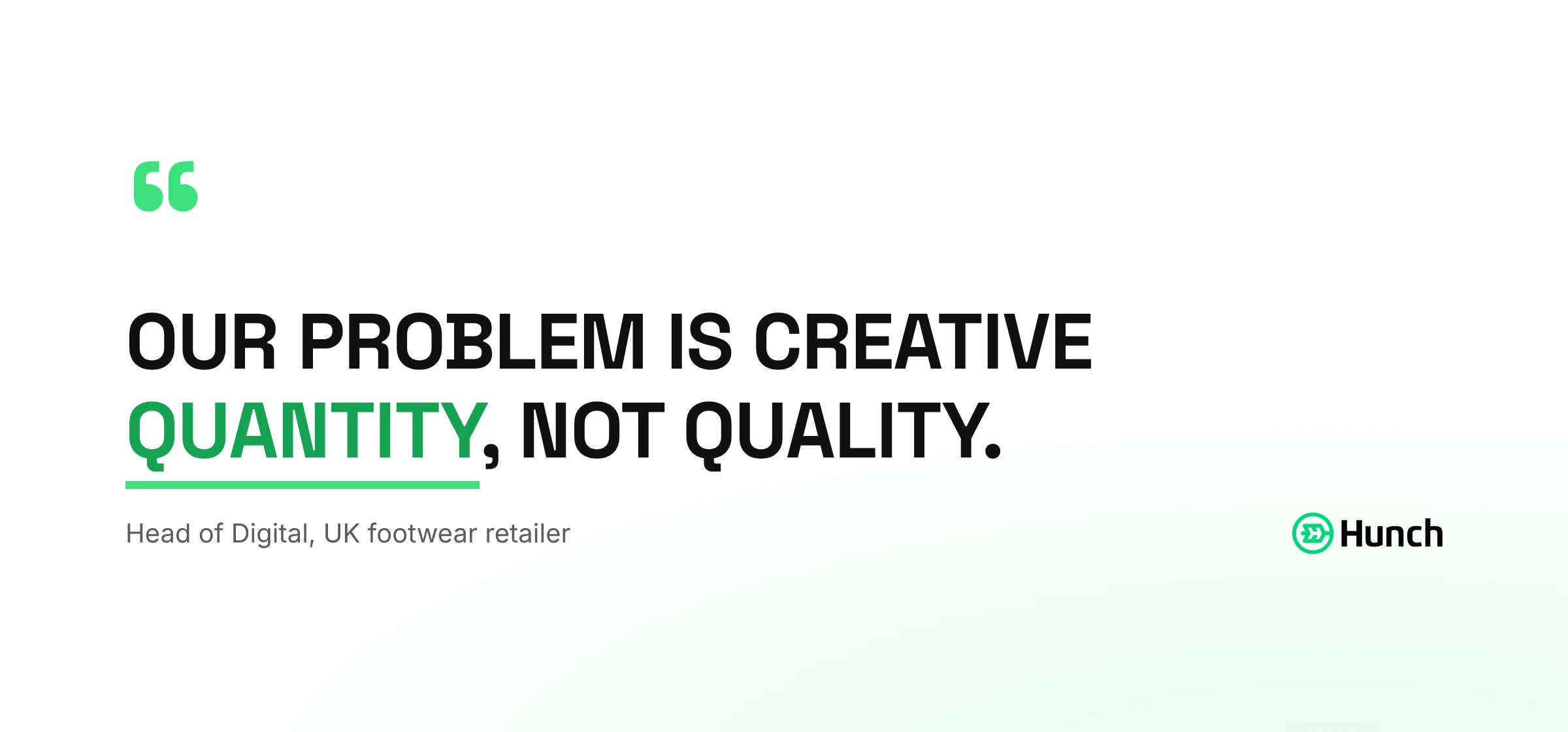
Head of Digital at a UK footwear retailer told us: "Our problem is creative quantity, not quality." Their in-house team ships five or six variants per campaign. Their media plan needs closer to thirty.
Every stage between brief and live ad is a translation step. Someone turns intent into files, files into versions, versions into campaigns, and every handoff adds another queue.
This guide shows where those queues form, how to diagnose them, and what creative performance platforms change. Numbers come from Hunch customers and from conversations with paid social teams at brands and agencies.
What is a paid social creative bottleneck?
Creative bottlenecks are steps between brief and live ad where work queues up faster than it clears. Media budgets scale overnight. Creative output scales with people, approvals and file handoffs, so it falls behind first.
You'll see it in performance data before anyone names it: frequency climbing on top ads, creative fatigue, learning phases that drag on, and new markets launching with home-market creatives.
Why do paid social teams struggle with creative production platforms?
Creative work passes through six stages, each with its own owner, tool and wait time. Fix one and queues move to the next. That's why buying design tools or hiring one more designer rarely moves launch dates much.
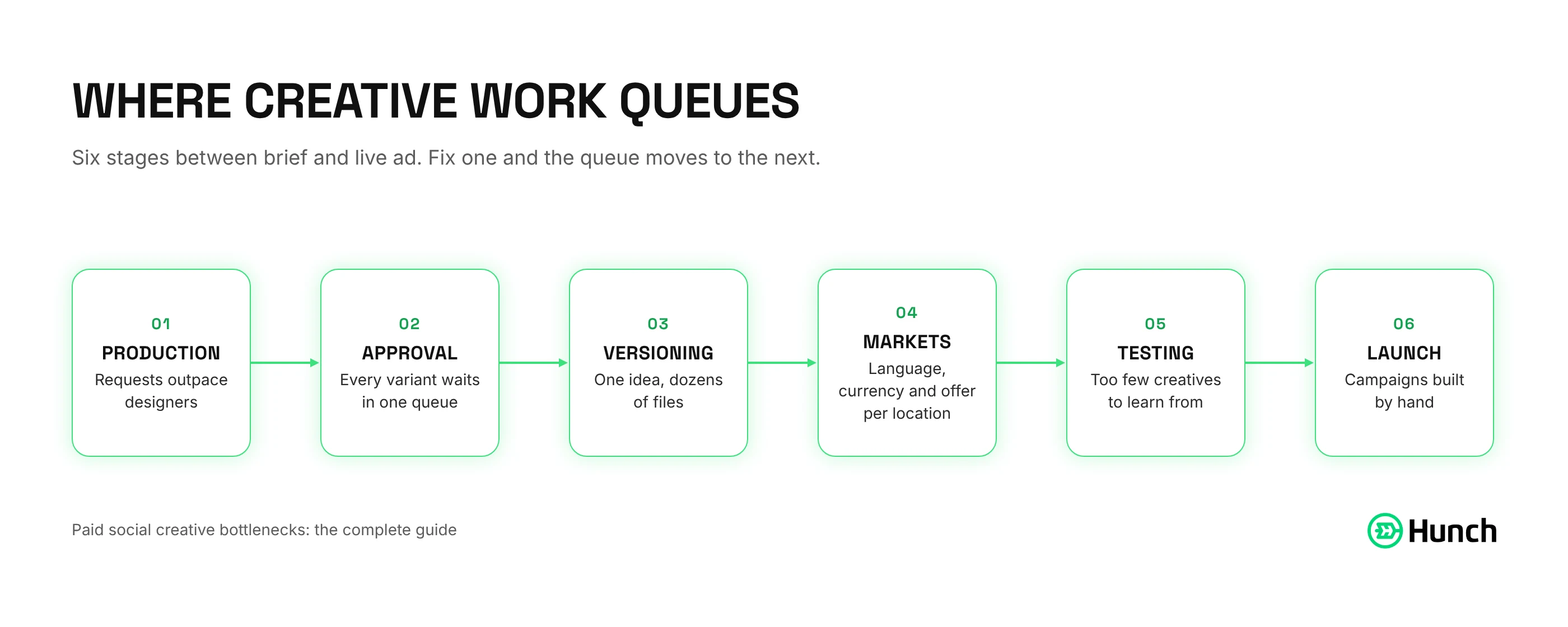
1. Production: requests outpace designers
Creative resource often sits in brand marketing, outside performance teams' control. Paid social competes with web, CRM and retail for the same designers. That footwear retailer put it bluntly: "Two more designers wouldn't fix it." Every new variant still needs designers' hands.
Quick checks
- How many unique creatives went live per ad set last month?
- What share of design requests were resizes or copy swaps?
- How many days pass from brief to first draft?
2. Approval: every variant waits in one queue
Brand and legal teams want visibility, and that's fair. Trouble starts when approval happens per ad instead of per system. Senior Creative Ops Manager at a UK activewear brand told us "9 times out of 10, it's fine." That tenth time sets everyone's pace.
Agencies feel this twice: once internally, once with clients.
Quick checks
- Do reviewers approve layouts once, or every single ad?
- How many feedback rounds do variants go through?
- Who can sign off on Friday afternoon?
3. Versioning: one idea, dozens of files
One concept becomes 1:1, 4:5 and 9:16, static and video, three price points, two CTAs. Lead gen director we spoke with runs three to six variations per creative line, then multiplies by placement.
Paid Social Manager at that activewear brand estimated four to five hours to set up one batch of ads, "providing nothing goes wrong."
Quick checks
- How many files does one concept produce before launch?
- Are prices, product names or stock typed into creatives by hand?
- How often do live ads show outdated prices or sold-out products?
4. Markets and locations: tailored ads everywhere you sell
Every market adds language, currency, offer and legal copy. Every store adds address, local offer and CTA. Growth marketing ops lead at a global entertainment subscription brand described producers briefing agencies country by country, adapting one hero asset dozens of times across 28 markets.
Quick checks
- How many markets or locations run national creatives because local versions weren't ready?
- How many days do new markets lag behind your home market?
- Who owns translation and pricing QA?
5. Testing throughput: too few creatives to learn from
Creative testing runs on volume. With five new variants a month, each test takes weeks to read, and creative fatigue often arrives before learnings do.
Travel marketplace team we spoke with runs three to six always-on campaigns per market and refreshes ads quarterly. When refresh cadence follows design capacity instead of performance data, testing has become a bottleneck.
Quick checks
- How many creative tests closed last month with clear winners?
- Is refresh cadence set by performance or by design capacity?
- Do winning elements feed straight into your next brief?
6. Launch: campaigns built by hand
Finished creatives still need campaigns, ad sets, naming, budgets and schedules. For teams running many accounts or locations, this step alone stalls rollouts. Lead gen champion at a multi-location brand told us manual rollout across their 500+ partners could take months.
Quick checks
- How many hours does one multi-market campaign take to build?
- Are campaigns duplicated and edited by hand?
- Can promos go live the day they're approved?
Creative bottleneck diagnostic checklist
Find where your queue sits. Start with whichever stage shows most red flags.
| Stage | Symptom in performance data | Quick check | Red flag |
|---|---|---|---|
| Production | Frequency rising on top ads | Unique creatives per ad set per month | New concepts wait behind resize work |
| Approval | Launch dates slip while budgets sit unspent | Feedback rounds per variant | Every single ad needs sign-off |
| Versioning | Wrong prices or stock in live ads | Manual data entry in creatives | Any price typed by hand |
| Markets and locations | New markets run home-market creatives | Days between home and new market launch | More than a week |
| Testing | Tests end inconclusive | Tests closed with clear winner per month | Refresh set by design capacity |
| Launch | Same-day launches impossible | Hours to build one multi-market campaign | Campaigns duplicated by hand |
How do creative performance platforms improve paid social campaign results?
Creative performance platforms connect creative production to data and media buying. Teams design layouts and rules once, then feeds, product data and performance results fill in variants.
Production: design systems instead of single ads
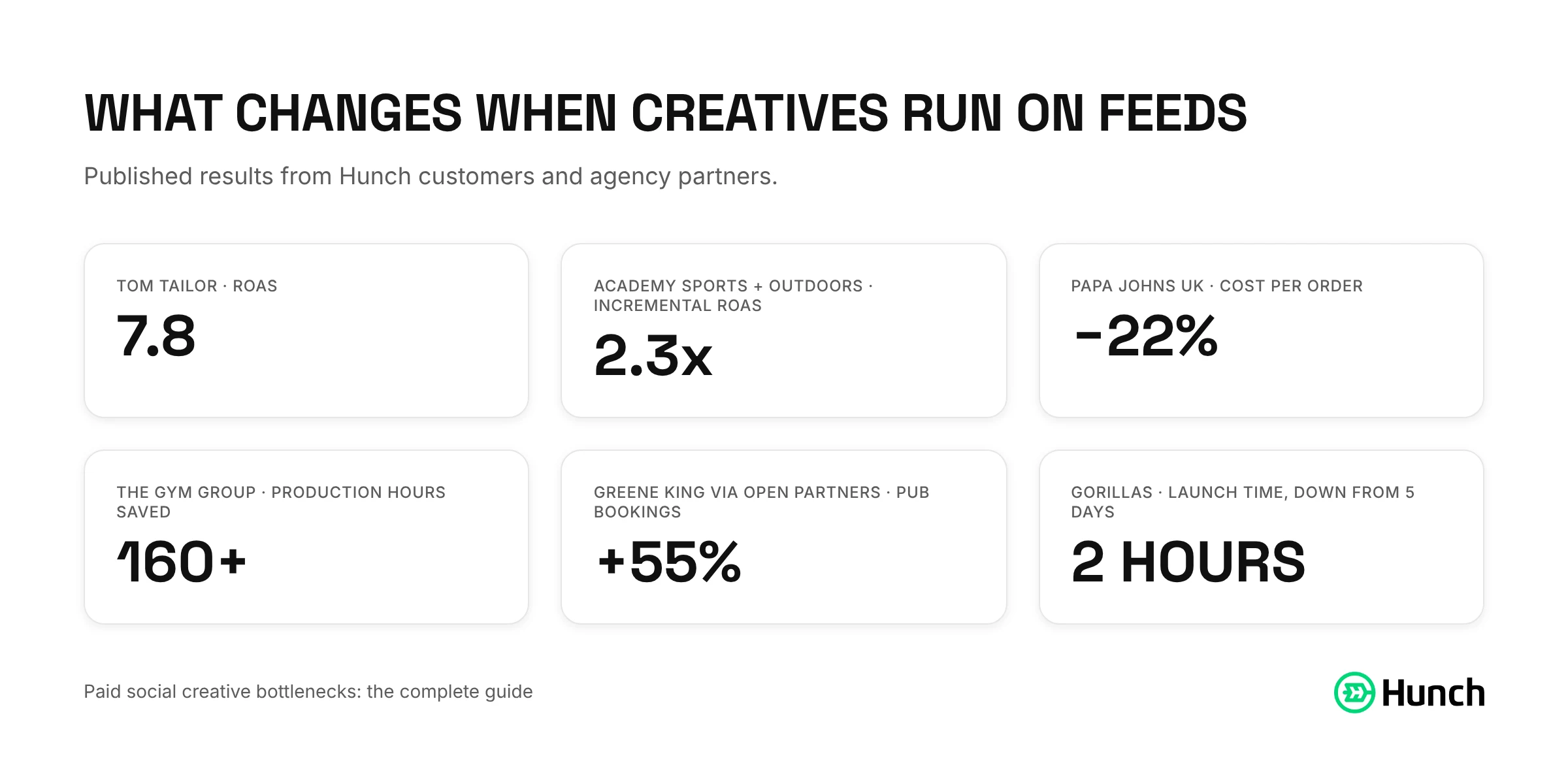
Designers build each layout once, and feeds generate every product, price and market version. Tom Tailor's two-person team scaled on-brand creatives across 38,000 products with PSD import, dynamic feeds and AI background removal, reaching 7.8 ROAS and cost per purchase under €2.50.
Agency Fingerspitz produced 4,000+ unique video ads with one designer managing all variations, and CTR rose 129%. Academy Sports + Outdoors removed backgrounds from 350,000 product images with AI. In Meta's Conversion Lift study, those enriched DPAs drove 2.3x incremental ROAS lift versus competitor overlay and no-overlay creatives.
Approval: sign off on rules once
Reviewers approve layouts, fonts, copy rules and safe zones. Variants generated inside those rules inherit approval, so review shifts from hundreds of ads to a handful of layouts. Netprofiler ran on-brand DPA campaigns for 10DAYS from designer-built creatives: 60% higher ROAS in the Netherlands and 106% in Germany.
Versioning: let feeds handle data
Prices, availability and product details come straight from feeds, so creatives stay current without anyone opening design files. Carwow's two-person team turned one product feed into testable data sets, with creatives refreshing on every dealer price update, and drove 242% ROI lift.
ManpowerGroup connected its live vacancy list to a feed, so every new opening gets location-specific creative and filled roles drop out. Production runs 4x faster.
Markets and locations: one creative, every location
Papa Johns UK and agency Bicycle turned one national creative into a few hundred store-specific Meta ads, with offer, copy and CTA pulled from a store feed. Cost per order dropped 22%.
The Gym Group runs every new gym through four messaging stages, from announcement to doors open. One feed and one automation plan swap creative and local copy per stage: 50+ openings, 300+ creatives and 160+ production hours saved, set up in four days. More on delivering tailored ads across markets and locations.
Testing: more variants, faster verdicts
More creatives per test means tests reach verdicts sooner, and performance data decides what runs next. WeRoad animated its best static destination creatives into catalog product video and ran both in shared ad sets.
Three-week A/B test in Italy: 16% more add-to-carts, 10% lower cost per add-to-cart, then budget scaled 4x. Our creative testing methodology for Meta covers how to set up tests like this.
Launch: push campaigns from one place
When creatives and campaigns live in one workflow, rollout becomes one step. For Greene King's Euros campaign, Open Partners entered two inputs per match: countries playing and match date. Hunch generated local inventory ads showing each viewer's closest pubs, and pub bookings rose 55%.
Gorillas cut launch time from five days to two hours across 8 markets and 400 locations. The multi-location lead gen brand above now rolls out new creative across 500+ partners within a day.
Which creative performance platform fits which bottleneck?
No single platform fixes all six stages equally. Pick by where your queue sits, your channels and your team setup. For full reviews, see our comparison of creative performance platforms for paid social.
| Platform | Best for | Strongest on | Watch out for |
|---|---|---|---|
| Hunch | Mid and upper-market brands and agencies with feeds, many markets or locations, on Meta, Snapchat and TikTok | Production, versioning, markets and locations, launch | Not a concept or UGC production tool; pair with creators for net-new ideas |
| Smartly | Enterprise brands and agencies buying across social, CTV and open web from one vendor | Production and launch at enterprise scale, plus incrementality measurement | Sales-led contracts and setup measured in weeks |
| Celtra | In-house creative ops at global brands producing across display, social and video | Production and approval governance, with AI-generated variants | No media buying layer; campaigns run elsewhere |
| Marpipe | E-commerce teams running catalog ads who want branded designs and multivariate tests | Testing on catalog creatives | Catalog-first; lighter on multi-location and campaign launch |
| Motion | Teams that need creative analytics on their own ad accounts | Testing insight: tagging hooks, formats and angles | Analyzes creatives; doesn't produce or launch them |
| Madgicx | Smaller e-commerce teams on Meta wanting AI optimization and quick ad generation | Testing and launch on Meta | Meta-first; generated ads are mostly static |
Where creative workflows go next
Every bottleneck above sits between what marketers want and what goes live. Years ago Hunch published The Second Act of Advertising with one promise: launching campaigns across hundreds of cities won't be a project, it'll be a prompt.
That's where we're heading. Marketers write one brief, and the system acts on it across production, versions, markets and launch. Humans still make the calls.
Where to start: 30-day plan
- Week 1: run the checklist. Count unique creatives per ad set and hours per launch.
- Week 2: pick your longest queue and ignore everything else for now.
- Week 3: move approvals to layout level for one campaign type.
- Week 4: run one feed-based test in one market against your current creatives. Compare CPA and hours spent.
Paid social teams need more creatives in auction: every market, every format, refreshed before fatigue sets in. Find where work queues, fix it, then move on.
If feed-based creatives and multi-market launches are where your queue sits, we're happy to show you how Hunch handles it. If not, this checklist works without us.
Frequently asked questions
Why do paid social teams struggle with creative production platforms?
Creative work passes through production, approval, versioning, market adaptation, testing and launch, and each stage has its own owner and tool. Platforms that only speed up design move the queue to approvals or launch. Teams see results when platforms cover stages where work actually waits.
How do creative performance platforms improve paid social campaign results?
They turn approved layouts into feed-driven variants, keep prices and availability current, adapt creatives per market or location, and push campaigns live from one workflow. More creatives in auction means faster tests and less creative fatigue. Hunch customers report results like 22% lower cost per order (Papa Johns UK) and 2.3x incremental ROAS lift (Academy Sports + Outdoors).
What's the first sign of a creative bottleneck?
Rising frequency and creative fatigue on top ads while budget sits unspent. If launch dates slip and media budgets don't, your constraint is creative.
Do creative performance platforms replace designers?
No. Designers shift from producing every file to building layouts and rules that generate files. Their work reaches more markets, formats and products.
