





Scaling automotive catalog ads from 200,000 to 350,000 vehicles sounds like a growth problem you'd love to have-until you realize your current creative automation partner just hit you with a 300% price increase. Now that growth problem becomes a budget crisis, and your design team can't possibly scale fast enough to handle the volume.
You're not alone. Performance marketing managers at automotive marketplaces and dealerships are hitting the same wall. Static overlays aren't cutting it anymore. You need dynamic video creative with seasonal messaging, automated background removal, and dealership-specific personalization. Plus, you're expanding to TikTok and Google Ads, which means even more creative variations to produce.
This article walks through the exact challenge one automotive marketplace faced when scaling from 200,000 to 350,000 vehicles-and how to solve it.
This article is for you if:
- You're advertising in the automotive industry with 50K+ vehicle inventory
- You're spending $50K-$100K monthly on paid social campaigns
- You're struggling with dynamic image and video generation at scale
The scale cliff: When automotive catalog advertising breaks
Your creative automation partner sends renewal pricing that's jumped 300%. Your design team can't keep up with seasonal messaging updates across channels. Static overlays that worked fine for Facebook feed ads look stale on TikTok. You're planning to expand to 350,000 vehicles next year, but your current infrastructure can barely handle what you've got now.
Around 200,000 vehicles, the math stops working in your favor. Each creative variation needs versions for different platforms, aspect ratios, and seasonal campaigns. A single promotional update (like a holiday financing offer) requires touching thousands of ads. Manual background removal alone becomes a full-time job when you're adding hundreds of new inventory photos weekly.
Your feed management gets messy, too. Vehicle attributes change constantly: pricing adjustments, mileage updates, new arrivals, and sold units. Legacy tools refresh feeds every 24 hours, which means you're advertising vehicles that sold yesterday or showing outdated prices. When you're operating at 200,000+ units with plans to hit 350,000, stale data directly impacts your cost per lead.
3 main challenges of scaling automotive catalogs
The breakdown happens in three specific places. These aren't philosophical problems about "efficiency" or "process optimization." They're concrete bottlenecks where manual workflows physically can't keep pace with catalog expansion, and where each workaround creates two new problems.
#1 Background removal and asset preparation
Every vehicle image that enters your feed needs background removal before it becomes ad-ready. Dealerships send photos with parking lots, showroom floors, and inconsistent lighting. Your team processes them manually, one by one, using Photoshop or online tools that handle maybe 20-30 images per hour if you're moving fast.
At 200,000 vehicles with inventory turning over monthly, you're looking at roughly 15,000-20,000 new images requiring prep work every single month. That's 500-700 hours of manual background removal. Scale to 350,000 vehicles and you're adding another 300+ hours monthly.
.webp)
#2 Template management without automation
Templates seem like the solution until you're managing variations across vehicle types, dealerships, promotional periods, and brand guidelines. Your sedan template needs different messaging than your SUV template. Dealership A wants their logo positioned differently from Dealership B. Summer clearance overlays replace spring promotional messaging, and someone needs to manually update 47 different template files.
Without automation, template management becomes version control chaos. You've got folders nested three levels deep, filenames like "sedan_template_v3_final_ACTUAL_final," and nobody's quite sure which version is live in which channel.
#3 Multi-channel creative adaptation
Facebook wants 1:1 ratio. Instagram Stories needs 9:16. Google Ads requires different specs entirely. TikTok's entering your media mix next quarter, bringing its own creative requirements. Every channel expansion multiplies your creative workload by however many format variations that platform demands.
Manual creative workflows assume you're optimizing for one, maybe two channels. They collapse completely when you're adapting the same vehicle catalog across four or five platforms simultaneously. Your team rebuilds essentially the same ad in five different dimensions, manually resizing, repositioning text overlays, adjusting aspect ratios. Scale that across 350,000 vehicles and you're not doing marketing anymore. You're doing data entry with extra steps.
How Hunch solves these challenges
We’ll address all three challenges and showcase the easier way to get the job done.
#1 Hunch AI background removal keeps you on brand
At 200,000+ vehicles, background removal alone becomes a production department.
Hunch eliminates this through built-in AI background removal embedded directly into dynamic creative production. As vehicle images enter your feed, backgrounds are removed automatically and placed into branded templates without designer intervention.
.webp)
This feeds directly into dynamic branded image and video ads. Once images are cleaned, Hunch generates multiple on-brand creatives, both static and video, automatically based on your vehicle feed. Pricing, mileage, and promotional messaging update dynamically. New vehicles generate creatives automatically.
#2 Dynamic templates to scale localization
Hunch replaces static templates with dynamic, rule-based templates connected directly to your catalog feed. Instead of maintaining dozens of versions for sedans, SUVs, or trucks, you define template logic once. Messaging adapts automatically based on vehicle type, attributes, or campaign timing.
This becomes even more critical at dealership level. With Dynamic Location Ads, templates automatically localize based on dealership data. Each dealership receives ads customized with its own location details, branding elements, and lead routing, without manual duplication of campaigns.
Each ad connects to its own lead form, and test drive requests are automatically routed to the correct dealership. That means scaling from 50 to 300+ dealerships does not multiply campaign management workload.
Templates stop being files. They become infrastructure.
#3 Placement-aware automation
The third challenge is channel fragmentation. Every new platform multiplies format requirements and production effort.
Hunch templates are built placement-aware from the start. A single creative system automatically adapts across Meta feeds, Stories, Reels, TikTok placements, and Google formats without manual resizing or repositioning overlays. Aspect ratios, safe zones, and specifications are handled automatically at the template level.
Collection ads further enhance this multi-channel strategy. A primary image or video is paired with multiple supporting vehicle visuals, creating an immersive browsing experience inside the platform. Users can explore multiple cars within one interaction, increasing engagement without multiplying creative production complexity.
The result is multi-channel expansion without multiplying manual work.
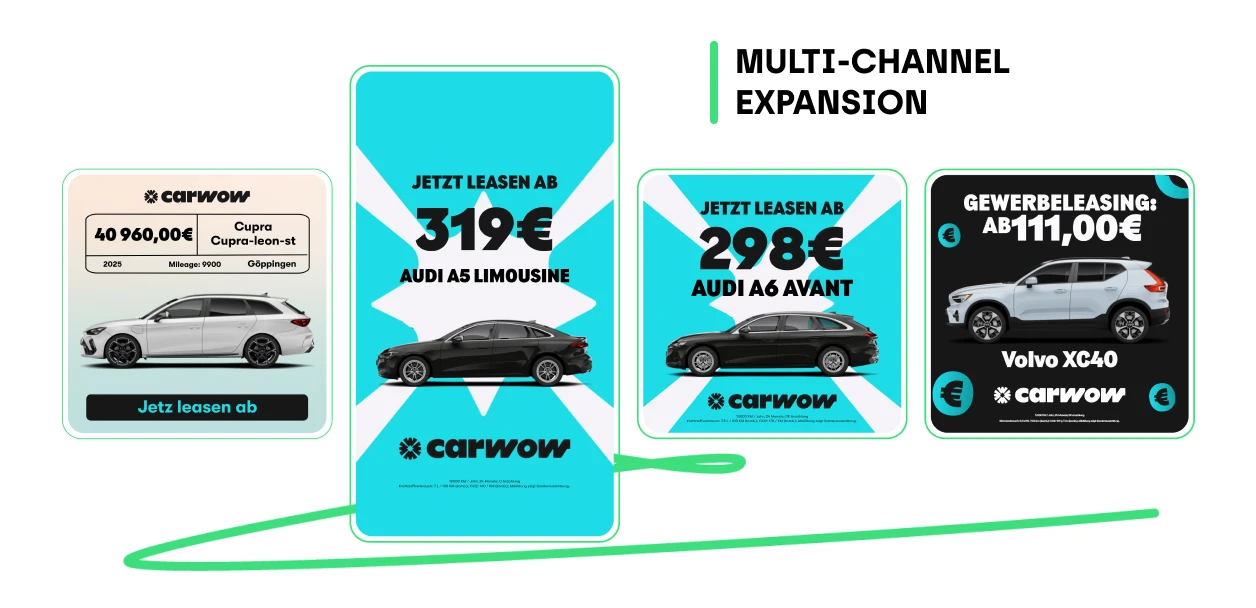
To see this in practice, check out how Carwow drove 242% ROI lift with Hunch’s automated feeds and dynamic creative.
