




Monday morning: a competitor drops a 200% first-deposit bonus across three markets. Your design team scrambles to update creative templates while you wait for your localization agency to translate new copy, and chase your feed integration partner to sync the latest offer data. By Wednesday, you've finally pushed refreshed ads live. By Thursday, the competitor's already moved to a different angle and you're back to coordinating between three separate platforms that don't talk to each other.
This is the reality when you're managing 1,500+ assets monthly across 50-70 ad formats with a fragmented vendor stack. Your designers aren't slow. Your tools aren't broken. The problem is structural: you're spending more time playing traffic controller between platforms than actually running campaigns, and that coordination overhead turns hours into days when speed directly impacts acquisition costs.
This article breaks down how multi-market iGaming operators should choose the right platform for scaling ads across channels and markets.
This article is for you if:
- You're running iGaming or casino operations in the US
- Your monthly ad spend is $1M or higher
- You're producing 1,500+ assets monthly across 50-70 formats and juggling multiple vendors for DCO, localization, and feed integration
Creative bottlenecks in high-velocity iGaming operations
Multi-market betting operators face a creative scaling problem that doesn't respond to traditional solutions. You can't hire your way out of it, and adding another project management tool won't fix it. The bottleneck exists because iGaming promotional velocity operates on a different timeline than standard marketing workflows were designed to handle.
Why creative demand outpaces traditional production models
The creative demand compounds across three dimensions simultaneously. First, there's promotional velocity. Offers change constantly based on odds, player behavior, and competitive pressure. That "bet $10 get $200" promotion needs to become "bet $30 get $300" by evening, and it needs to happen across every active format and market.
Second, different regulatory environments, languages, currencies, and cultural contexts mean each offer requires genuine localization, not just translation. A single promotion for five markets might require 350 distinct assets when you factor in format variations and A/B testing.
Third, performance pressure eliminates the luxury of long creative lifespans. Ad fatigue hits fast in competitive iGaming markets. The creative that delivered a $47 player acquisition cost last week is pulling $89 this week, and you don't have time to wait for your design team to concept three new directions.
The multi-vendor trap
Most operators arrive at the same solution: specialized vendors for each problem. One platform handles dynamic creative optimization. Another manages localization. A third covers feed integration for odds and offers.
.webp)
The vendor stack solves individual problems while creating a bigger one. Your team spends more time managing coordination between platforms than actually improving performance. Version control turns into a nightmare when the same offer exists across four different systems in various states of completion.
The commercial model gets expensive fast, too. You're paying platform fees to multiple vendors, often with usage-based pricing that scales painfully as your volume grows. When you're producing 1,500 assets monthly and that number keeps climbing, the cost structure starts looking like a second ad budget.
How workflow friction kills campaign results
When it takes three days to update an offer across all active formats, you're running stale promotions while competitors iterate. Those 72 hours of lag time translate to higher acquisition costs and lower conversion rates.
.webp)
Creative testing becomes shallow by necessity. You want to run significant creative variations with distinct concepts and motion elements, but your production capacity only allows for basic A/B tests on headline copy. The testing strategy you need requires production velocity you don't have.
What to look for in a creative automation tool
The vendors competing for your budget will all claim they solve creative scaling. The difference shows up six months post-implementation, when you discover whether you've consolidated workflows or just added another login to the stack.
Workflow consolidation vs. feature breadth
The right platform eliminates vendor dependencies rather than creates new specializations. If updating a promotional offer still requires contacting your design agency, or if localizing assets for a new market means opening tickets with your feed management vendor, you haven't solved the coordination problem. You've just paid for a different bottleneck.
.webp)
Dynamic asset creation for multi-market operations
Look for platforms where creative variations pull directly from your product catalog or promotional database. When odds change or regulatory requirements shift between markets, your creative production shouldn't require designer intervention. The asset updates should happen automatically once the source data changes.
This matters especially for creative testing. If you prefer testing distinct motion concepts over simple headline swaps, your platform needs to generate multiple creative directions from the same data inputs without rebuilding templates from scratch. The speed difference between "request three concepts from the design team" and "generate three motion variations from existing templates" is the difference between testing weekly and testing daily.
Integration with performance feedback loops
Creative production and performance analysis live in separate tools at most operators. Designers build assets in one platform, media buyers launch campaigns in Meta or TikTok, and performance analysts export data to spreadsheets. By the time insights reach the creative team, the promotional window has closed.
The platforms worth evaluating build performance feedback directly into the creative workflow. When a specific offer format or motion style drives lower player acquisition costs, that insight should inform template prioritization automatically.
For operators pushing $5 million in monthly ad spend, closing this feedback gap translates directly to cost per acquisition improvements. The faster your creative team sees which variations perform, the faster they stop producing the formats that don't.
Why Hunch is the structural fix for iGaming creative scaling
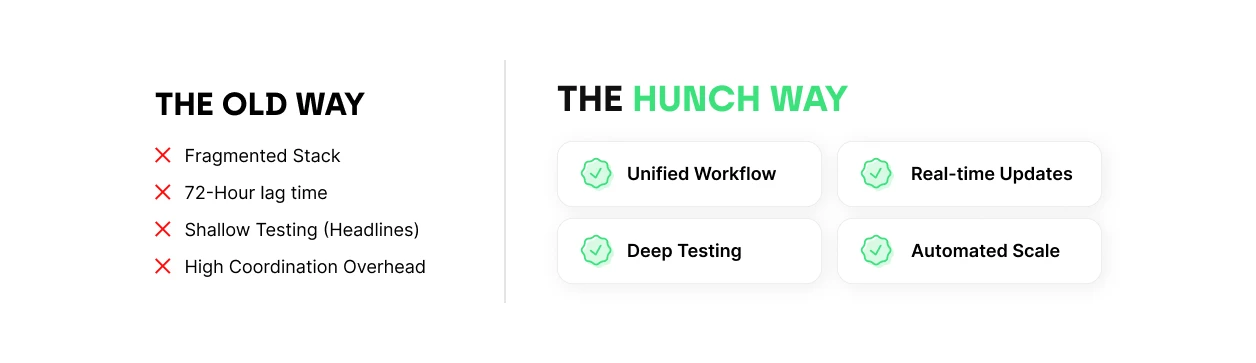
Hunch unifies creative automation, feed logic, and activation into one workflow. When odds or promotions change, assets automatically regenerate and deploy across formats and markets, no ticketing, no manual handoffs. Localization and compliance are built into the same system, pulling from live feeds to generate thousands of market-specific variations instantly.
Performance data is integrated directly into the creative process. With unified Meta, Snapchat, and TikTok insights, operators can quickly identify which formats and offers drive the lowest CPAs and automatically scale the winners. The result is a closed-loop system built for daily iteration, not weekly delays.
