





Most advertisers treat Meta’s dynamic creative as a "set-it-and-forget-it" feature. But if you’re managing high-spend accounts, you know that hitting a performance ceiling is inevitable without a sophisticated dynamic creative optimization (DCO) strategy.
While Meta’s native tool handles the assembly, true DCO is about the feedback loop: using real-time data signals, like weather, price fluctuations, or localized inventory, to dictate which creative assets are produced in the first place.
Drawing on Hunch’s experience running 200 million automated ads, this guide skips basic definitions and dives into the high-level tactics required for dynamic creative optimization on Meta.
The DCO mindset: The "automated chef"
Imagine you’re hosting a dinner party for your family and friends. Your best friend is allergic to nuts, your cousin won’t touch gluten, and your sibling has recently turned vegan.
You have to cater to a wide variety of tastes. Wouldn’t it be nice if the ingredients could rearrange themselves to form the perfect meal for each guest?
Paid Social is exactly like that. Except, advertisers don’t always know for sure what their audience truly wants.
The difference between the tool and the strategy:
- Meta’s Dynamic Creative (The Tool): It takes your pre-made ingredients (assets) and swaps them to see what sticks.
- DCO (The Strategy): This is the "Automated Chef." It uses first-party data to decide which ingredients to buy and how to cook them before the guest even sits down.
If you’ve been around the block, standard dynamic ads aren’t news to you. What sets you apart now is how you move from "testing assets" to "building a creative intelligence engine."
Key takeaways: Mastering dynamic creative optimization on Meta
Before diving into the full guide, here are the essential pillars of a high-performance dynamic creative optimization on Meta strategy for 2026:
- Bridge the capacity gap: Automating creative production allows performance teams to scale testing volume by 85% without increasing design headcount, solving the friction between "performance needs" and "design bandwidth."
- Beat creative fatigue: In the age of Advantage+ Creative, dynamic creative optimization on Meta acts as a "live" feedback loop, refreshing assets based on real-time performance data to maintain high ROAS and prevent the "learning phase" reset.
- Hyper-localization is the lever: Success stories from brands like Carrefour and Academy Sports show that layering location-based data with time-sensitive triggers (like countdowns) can drive up to a 31% higher ROAS.
- Video-first automation: To win in 2026, brands must transition from static catalog ads to Catalog Product Videos (CPV), blending lifestyle content with dynamic overlays for 47% higher CTRs on Reels.
Dynamic creative optimization in the age of Meta advantage+ creative
As Meta moves toward advantage+ creative, the role of the advertiser has shifted from "manual tester" to "data architect." Advantage+ uses machine learning to apply enhancements like image expansion or music overlays.

However, professional DCO involves automated creative production. Instead of letting Meta's AI "guess" how to crop an image, DCO ensures your templates are pre-optimized for every aspect ratio and localized for every market before they hit the auction. This increases your Estimated Action Rate, which lowers your CPMs.
DCO strategy for Meta: Best practices & expert tips
Here’s a quick summary of what you should do and what to avoid:
- Zero in on the right creative assets: Prioritize quality, not quantity — creative is the biggest lever you can pull to unlock growth. Remove background with AI and make your DPAs pop.
- Try multiple call-to-action(CTA) buttons: You don’t know yet what your audience wants — give them more than one option so you can test your hypotheses.
- Create succinct ad copy: Meta users are geared to like short-form content, so you want to create scroll-stopping copy.
- Grab attention with your visuals: Make sure your creative isn’t busy and has a single point of focus. you can use readymade templates to create stunning image and video ads.
- Win on video-first placements: Convert your catalog into animated Catalog Product Videos (CPV), blending lifestyle footage with dynamic overlays
- Get rid of text in ad images: Unless absolutely necessary, avoid text in the images since they can make the image feel busy or get lost due to contrast issues.
- Optimize for the first few seconds: Video ads perform better on Facebook and Instagram when the first few seconds draw the user in.
- Don’t forget your branding: You’d be surprised at how easy it is to increase brand recall just by adding your brand name and logo at the end of the video.
- Design videos for audio-less moments: Don’t rely on sound to sell your product. When users consume content in public spaces, the audio is usually off by default. Add closed captioning to your videos to tell your story instead.
- Go with the vertical aspect ratio: In the ege of Reels and TikToks, vertical wins over any other aspect ratio.
Below, you’ll find the three practical use cases of dynamic creative optimization strategy.
Bear in mind, this is by no means an exhaustive list and we can always create a customized solution for your client's brand.
3 Use cases of dynamic creative optimization on Meta (+ Real life examples)
Below, you’ll find the three most important tips you’ll want to use to create a dynamic creative optimization strategy.
Bear in mind, this is by no means an exhaustive list and we can always create a customized solution for your client's brand.
If you’ve already been using dynamic creative ads, these three pillars will help you overcome common pitfalls and scale ROAS.
DCO use case #1: Use multi-signal data to create "hyper-local" urgency
You know that personalization leads to better ROAS, but true optimization happens when you combine data points to create relevance that feels "live." Many brands stop at just one signal, but the most successful campaigns layer them.
Take So Buzzy and their work with retail giant Carrefour. They didn’t just show products; they used Hunch to build a DCO engine that combined location data with time-sensitive triggers:
- Hyper-local recipes: Ingredients in the creative changed based on the user's nearest Carrefour branch.
- Automated Countdown Ads: Real-time "FOMO" ads that updated every 24 hours to show exactly how many days were left for a specific promotion.
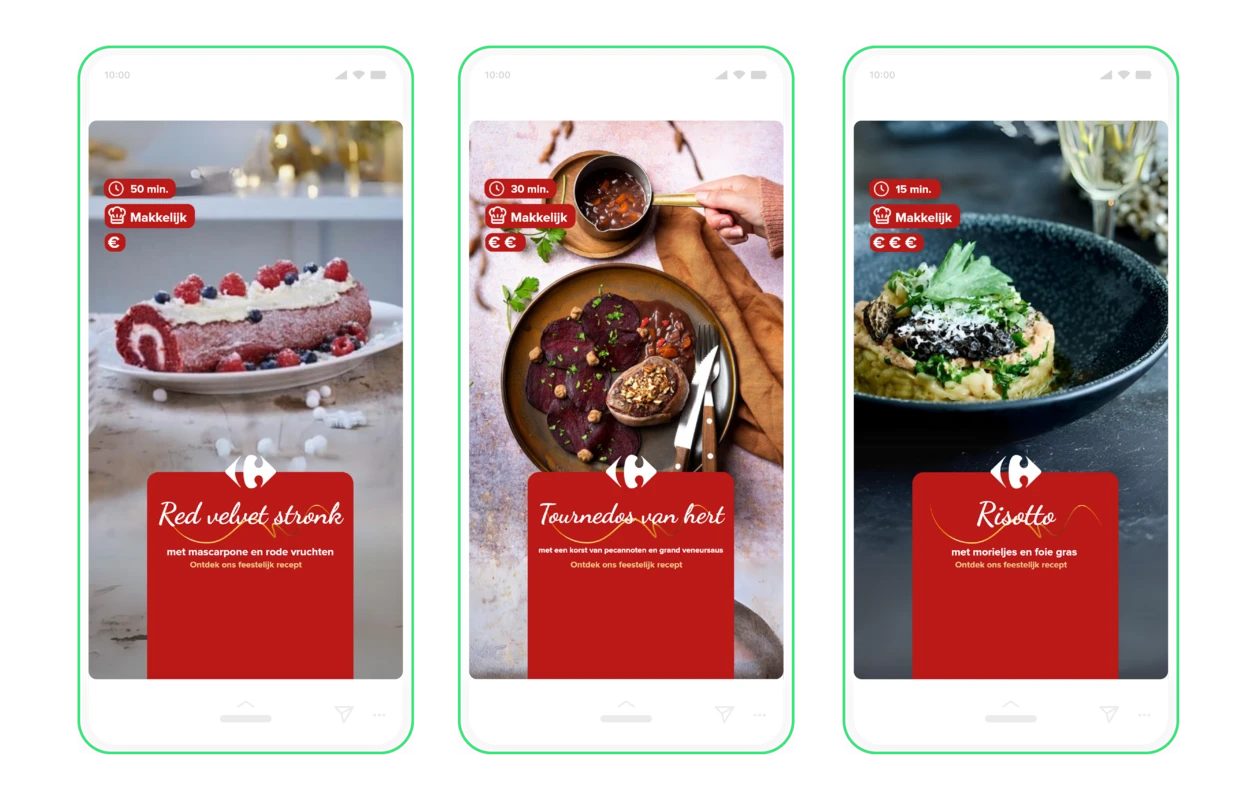
By automating this across thousands of variations, they achieved a 31% higher ROAS and saved over 250 hours of manual work. The lesson? Don’t just personalize; use DCO to make your ads feel like they are happening in the "now."Read the whole customer story.
DCO Use Case #2: Solve the "Creative Gap" Between Performance and Design
A major hurdle in DCO is the friction between the performance team’s need for volume and the design team’s limited bandwidth. To optimize, you have to move away from manual asset creation and toward automated creative production.
Vitapur is the perfect example of how to bridge this gap. As a brand operating across multiple international markets, they needed to launch massive volumes of localized offers without exploding their design costs.
- By connecting their product feed directly to Hunch, they turned a single spreadsheet into thousands of high-converting image and video ads.
- This allowed their team to focus on high-level strategy rather than resizing banners for different regions.

This shift to a feed-based DCO strategy resulted in a 25% ROAS growth and a 47% increase in CTR, and you can dig deeper about how Vitapur did it with Hunch powered catalogs.
DCO Use Case #3: Use DCO to win the battle against ad fatigue
Even the best creative has a shelf life. On Meta, ad fatigue is the silent killer of ROAS. To keep performance high, you need a system that can refresh assets instantly without restarting the "Learning Phase" from scratch.
Look at how Otrium uses DCO to stay ahead. As a high-growth fashion outlet, they deal with massive inventory turnover. They used Hunch to implement a sophisticated DCO workflow that:
- Combined dynamic product overlays with high-end aesthetic templates.
- Automated the testing of different "purchase motivators" (like price drops or low-stock alerts) directly on the creative.
By letting the data dictate the creative refresh, they saw a massive power lift in their campaign performance, maintaining efficiency even as they scaled spend. If you want to scale, stop thinking about "launching a campaign" and start thinking about building a dynamic creative system that evolves in real-time.
Read full customer story: Otrium ran a Power Lift Study with Hunch resulting in a 366k brand lift.
Not a solo flight: dynamic creative Ads for Facebook and Instagram
Meta’s Ads Manager is an excellent starting point for businesses that want to start experimenting with dynamic creative ads.
But it’s not a tool you should use in a vacuum. Dynamic creative ads are best paired with other Meta ad products (as clearly evidenced by their case studies). And you should combine first and third-party data to personalize your ads that Meta Business Partners like Hunch can help you with.
The secret to succeeding with dynamic creative ads on Facebook and Instagram ads is simple — have a solid DCO strategy in place, personalize using multiple data points, and automate your production and management.
Hunch works with brands and agencies like yours to create customized DCO strategies for Meta, Snapchat and TikTok. Want to get on a free strategy call? Book yours here!
Frequently Asked Questions
Are there any DCO examples for Facebook and Instagram?
We’ve compiled a list of 20 dynamic creative examples you can use for your next campaign. These campaigns include using weather intelligence (temperature, rain, cold, snow) to trigger ads, multi-language localization to appeal to locals, location intelligence (personalization based on postal codes), and time-triggered ads. And if you need more inspiration for DPAs, check out Hunch’s creative examples across different product categories.
What are DCO ads used for?
DCO enables advertisers to test which ad performs best by dynamically delivering different combinations of creatives to the target audience. You can use a combination of 10 images or videos, 5 titles, 5 text variations, 5 descriptions, and 5 CTA buttons.
How does Instagram/Facebook DCO work in real-time?
Meta’s dynamic creative feature uses the assets you upload and treats them as individual components to create multiple ad variants and test them across different audience segments.
According to Meta, “When it comes to the creative, it is never one size fits all. Great creative finds the perfect match between your ad and your audience.”
You offer up a range of 30 components, specify who you want to reach, and your budget and Meta takes care of the rest. It saves time, money, and effort.
Could you run the same test manually?
Yes!
But, it will require heaps of effort and will cost you ad dollars that you can save with Meta’s dynamic creative.
So, what can you test?
You can have:
- 10 Images or 10 Videos
- 5 Text Descriptions
- 5 News Feed Link Descriptions
- 5 CTA Buttons
- 5 Headlines/Titles
- 1 Website URL
- 1 Display URL
Meta determines different ad combos based on the ad performance but also takes into account user fatigue and ad frequency.
