





You've seen them in Meta's ad library - hundreds of identical ads from competitors, each one calling out a different city. "Do you own a home in Chicago?" Then another: "Do you own a home in Miami?" Same offer, same creative structure, different location. They're clearly running something automated, and it's working well enough that they're scaling it across 500+ markets.
Meanwhile, you're stuck choosing between two bad options: run generic ads that ignore location entirely, or manually build localized campaigns for your top markets and leave money on the table everywhere else.
The gap between manual work and what competitors are doing with automation isn't just frustrating - it's expensive. At $100k+ monthly spend, the 20-40% cost per lead improvement from localized creative adds up fast.
This article walks through the practical solution to scaling geo-targeted ads across 1,000+ locations, from creative production to Meta's local inventory catalog system that makes dynamic localization possible without fragmenting campaigns into thousands of ad sets.
This article is for
- Performance marketers running multi-location lead gen campaigns.
- Marketing directors at home services, solar, or franchises spending $100k+ monthly
- Media buyers who understand Meta's auction mechanics but need the creative production system to actually execute localized campaigns
Why lead gen depends on hyper-local relevance
Lead generation economics are brutally simple: your cost per lead determines whether you're profitable or burning cash. When you're selling leads to local contractors who service specific territories, the quality signal starts with relevance. A homeowner in Miami scrolling past a generic "bathroom remodeling" ad processes it as noise. That same person seeing "Miami homeowners: walk-in tub installation" stops scrolling.
The auction dynamics reinforce this. Meta's algorithm rewards ads that generate engagement in specific geographic segments. When your creative includes local call-outs, you're signaling relevance before the user even clicks. Higher CTR, better engagement rates, and lower CPMs follow. For lead gen companies operating on thin margins where a $2 difference in cost per lead determines profitability, this is survival.
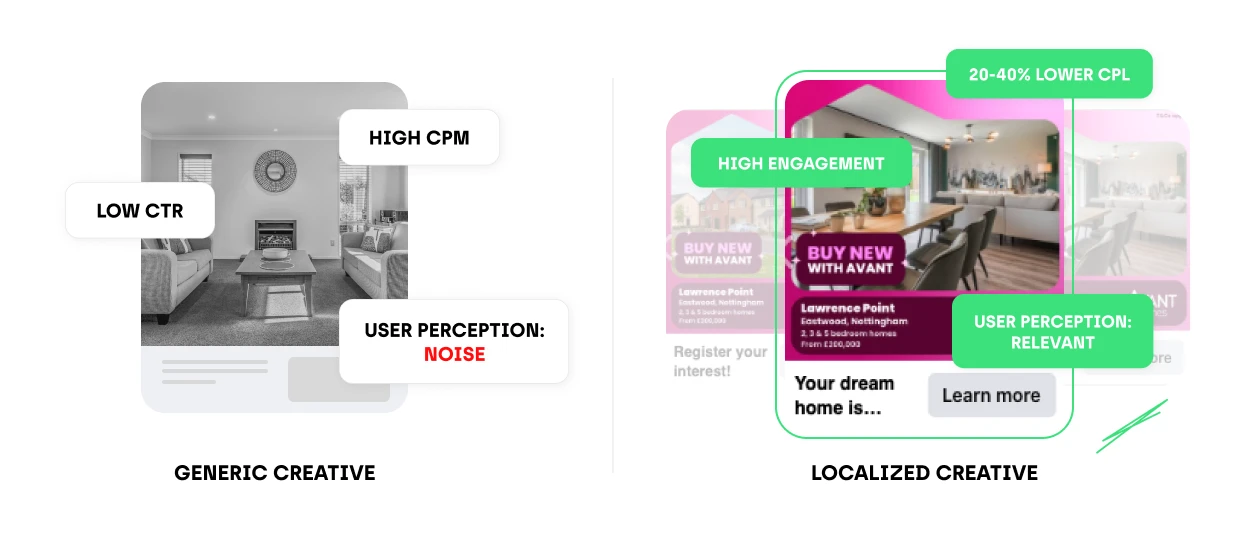
The challenge intensifies when you're managing coverage across 1,400 to 30,000 ZIP codes. You can't just "go local" by creating a Miami campaign and a Phoenix campaign. You need systematic personalization that scales to every market you serve, updates when coverage changes, and maintains consistent quality across hundreds or thousands of variations.
How top competitors actually scale localized ads
Check Meta's ad library for any scaled lead gen competitor. You'll find 500+ active ads that are functionally identical except for the geographic call-out. They're using creative automation systems that connect spreadsheets of targeting data to template-based ad production. When they update a ZIP code list or change a coverage area, new localized ads generate and traffic automatically.
The video personalization is the tell. These aren't just swapping headline text - the first 3-5 seconds of video includes an AI-generated voiceover calling out the specific city. The system renders unique video files for each location, overlays the city name, generates the corresponding audio, and pushes everything to Meta with the correct geographic targeting already mapped.
The infrastructure behind those hundreds of personalized ads isn't nearly as complex as you'd think. Let's break it down.
The technical requirements for hyper-localization at scale
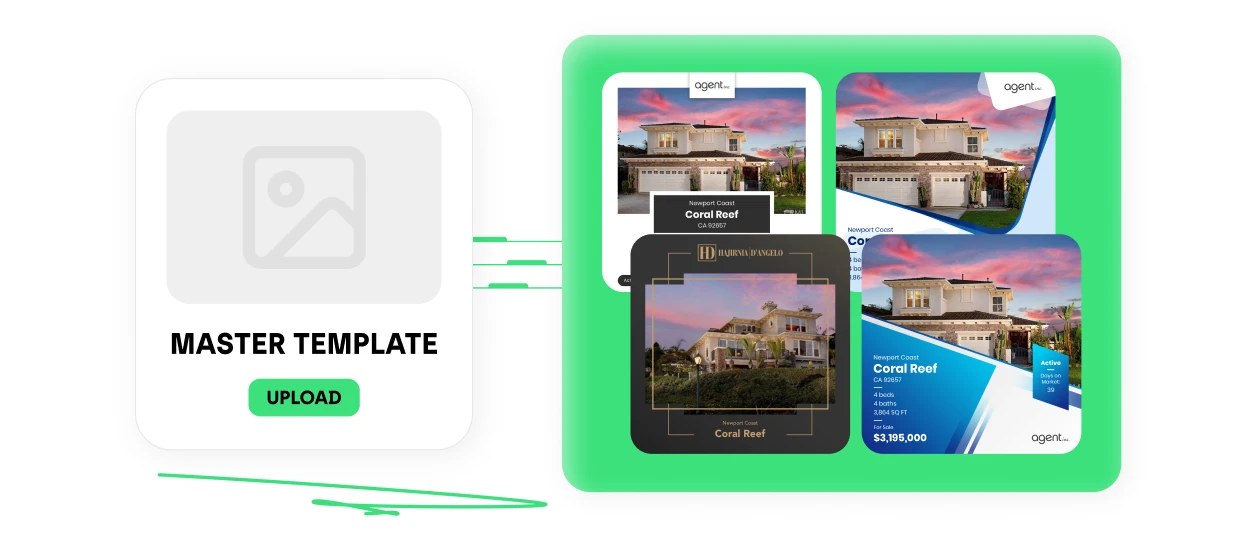
At its core, scaling geo-targeted creative across thousands of locations requires three technical capabilities working together. You need a data layer that maps creative elements to geographic targeting, a rendering engine that produces localized assets on demand, and an automated deployment system that pushes everything to Meta without manual intervention. Miss any one of these, and you're back to manual campaign creation.
The foundation is simpler than you'd expect, it’s a data-driven model where a Google spreadsheet or a product feed acts as your control center. In Hunch, each row represents one geographic market with columns for ZIP code targeting, budget allocation, and localized copy. When you're running across 5,000 ZIP codes, this becomes your single source of truth. By syncing this data source directly with the platform, you can update 5,000 ads by changing a single cell in your sheet rather than rebuilding campaign structures in Meta.
Using catalog product videos for localization
Video localization has traditionally been the biggest bottleneck, but the approach used by top competitors involves converting static data or existing footage into high-impact Catalog Product Videos (CPV). Instead of manually editing hundreds of video files, Hunch uses a template to overlay dynamic text onto your base footage. The first 3-5 seconds of the video can call out the specific city, while the visual overlays display "Available in Scottsdale" or "Now Serving Phoenix" based on the user's location.
This rendering engine generates unique video files for each market, ensuring that users see their specific city mentioned in high-quality video formats like Reels or TikTok. By treating video production as an automated rendering task rather than a manual editing task, you can test multiple video angles across all your locations simultaneously. This allows you to fight ad fatigue across 500+ markets without increasing your design team's workload.
Automated deployment through local inventory catalogs
The final layer is the connection to the Meta API, specifically utilizing a local inventory catalog approach. This system allows you to run dynamic localization without fragmenting your account into thousands of individual ad sets. Through Hunch, you create one campaign with one audience targeting your full coverage area, and the catalog determines which creative variation appears in each ZIP code. When Meta serves an impression in a specific ZIP code, it automatically pulls the corresponding localized ad from your feed.
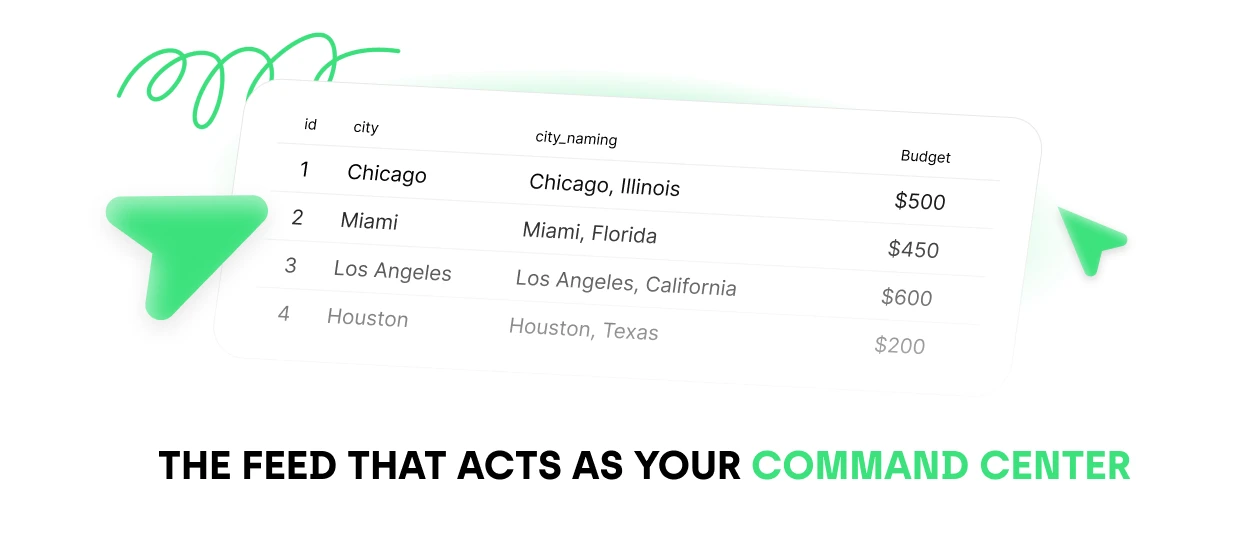
This structure allows for automated performance management. Your data source can display cost per lead by market, automatically pause underperforming locations when CPL exceeds your threshold, and flag geographic clusters that need a creative refresh. You are no longer logging into Ads Manager to manually adjust 800 ad sets; instead, you are managing a data-driven system that identifies winning assets and scales them across your entire coverage area automatically.
See how we used local inventory ads to boost Greene King’s pub bookings by 55%.
The bottom line
Scaling geo-targeted ads across thousands of locations doesn’t require more campaign managers; it requires the right infrastructure. With Hunch, your product or location feed connects directly to dynamic templates, and our rendering engine automatically generates localized ads at scale. Each location gets the right messaging, visuals, and landing experience without manual duplication or campaign sprawl.
Instead of building ads one by one, Hunch turns your feed into a fully automated, location-aware advertising system that scales performance.
