





You're running catalog ads on Meta. You've tuned the creative, tightened the bidding, and built a solid feed. Yet there's one decision you don't get to make: which products actually get shown. Meta's delivery algorithm picks favorites from your catalog, but even the best algorithms are limited by the data they can see. In a landscape where signals are often fragmented, Meta naturally leans toward products with the highest historical engagement to ensure delivery stability.
This creates a hidden opportunity for advertisers. While Meta optimizes based on the signals it receives, there is a wealth of 1st-party data (conversions, margins, and stock levels) that sits outside Meta’s immediate view. Without that bridge, high-potential products can remain under-leveraged while budget gravitates toward a narrow selection of "proven" items.
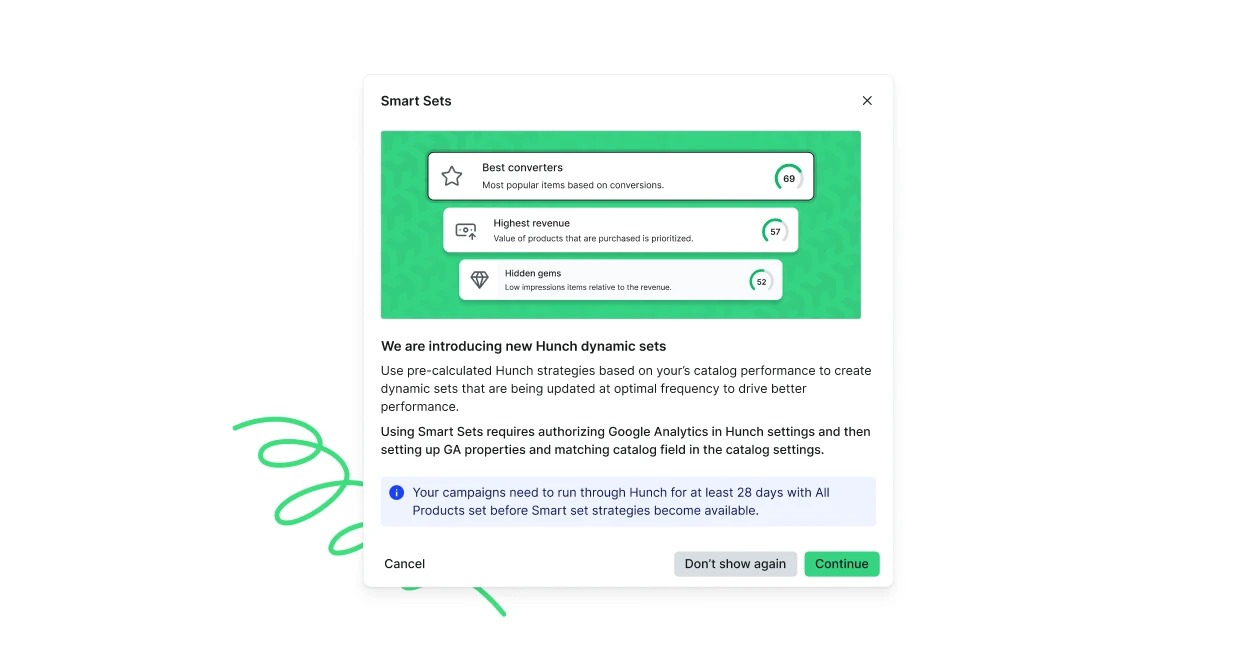
Smart Sets were built to bridge this gap. We designed this for retailers and performance marketers to help Meta’s delivery engine work smarter by feeding it 1st-party insights.
TL;DR
- Empowering Meta with 1st-party data – Meta’s external tracking limitations (like iOS/Cookies) can narrow its focus. Smart Sets provide the 1st-party context Meta needs to find more winners in your catalog.
- Performance-led product selection – Instead of manual campaign restructuring that dilutes data density, Smart Sets use 1st-party signals to feed Meta a high-intent product pool.
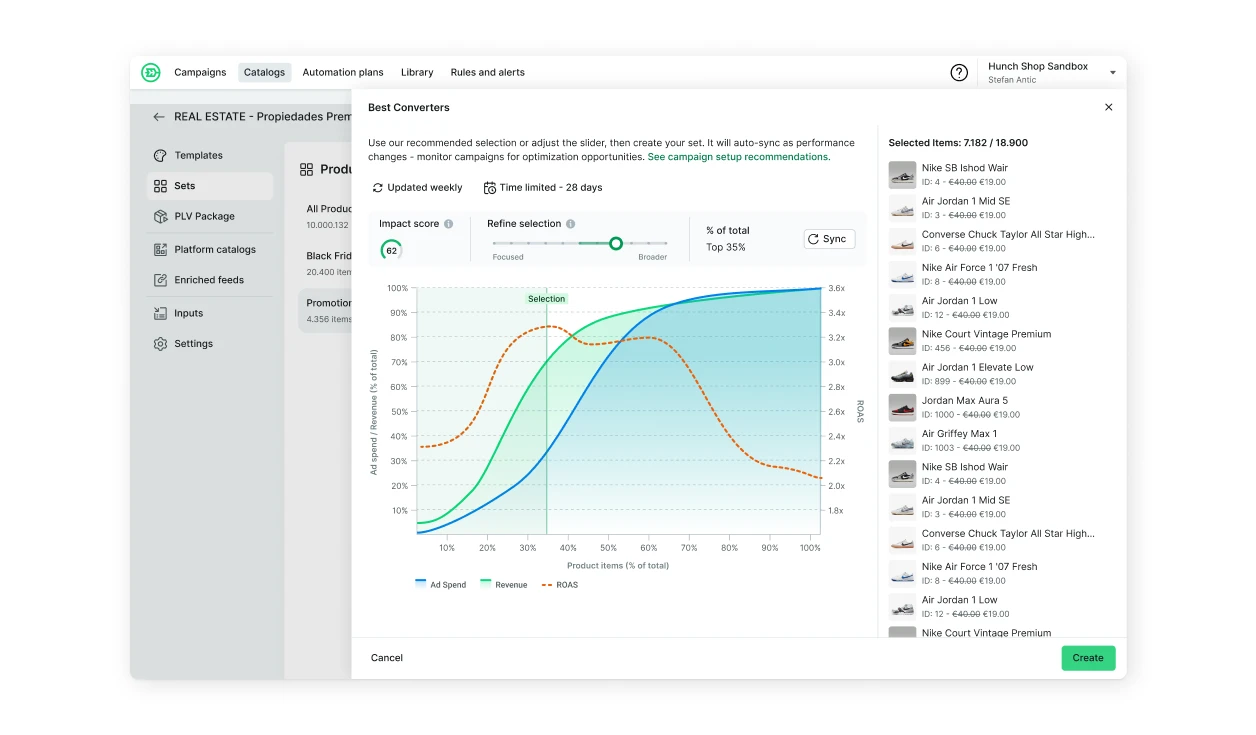
- Smart Sets shape the product pool before the auction - They use GA4 and Meta metrics from the last 28 days to auto-select products based on five distinct strategies, refreshed weekly.
- Two strategy types for different goals - Inclusion strategies (Best Converters, Highest Revenue, Hidden Gems) run alongside your BAU ads; exclusion strategies (Insufficient ROAS, Eye Candy) can replace them entirely.
- Otrium's Hidden Gems test delivered real results - 7.8% revenue uplift in NL and 6.5% in DE, with CTR jumps of 30-41% across markets, no budget increase required.
The opportunity: Helping Meta see the full picture
When you run a catalog campaign, Meta’s primary goal is to find the most likely buyer for a product. However, because of the signal loss caused by third-party cookie restrictions, the platform often has to play it safe. It prioritizes products that already have massive engagement, which can sometimes leave "hidden gems" or high-margin items sidelined simply because they lack the initial data signals Meta requires.
Many brands try to solve this by forcing delivery through granular ad sets, but this often backfires by reducing data density and pushing campaigns back into the learning phase.
Introducing Smart Sets: what they are and how they work
Smart Sets use GA4 and Meta product metrics to automatically build dynamic product sets based on 28 days of performance data, refreshed every week. No manual updates required. They analyze performance patterns across Meta and Google Analytics to spot products that drain spend without converting.

There are two types:
- Inclusion strategies surface your top-performing or underexposed products and run alongside your regular ads - ideal for testing, scaling winners, and discovery.
- Exclusion strategies remove the weakest performers from your main campaigns and can replace your BAU setup entirely.
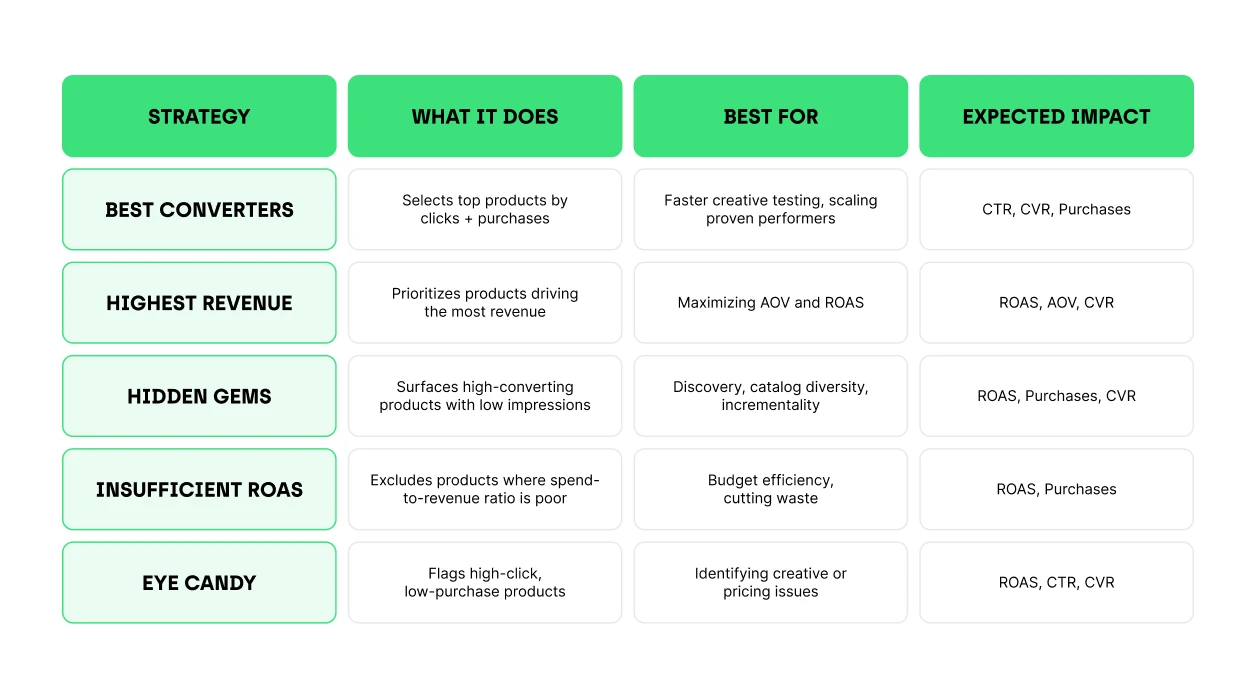
The product count is adjustable with a slider: inclusion strategies pull 10-40% of your catalog, while exclusion strategies remove 60-90%. You can adjust this while campaigns are running. For inclusion strategies, we recommend running alongside BAU for up to four weeks, then reviewing and rotating. Exclusion strategies can run indefinitely.
How Otrium used Hidden Gems to unlock incremental revenue
Otrium is an online fashion outlet with hundreds of designer stores all in one place. They were running retention DPA campaigns on Meta across the Netherlands and Germany and asked a straightforward question: could a Hidden Gems product set improve retention performance without increasing cost per purchase?
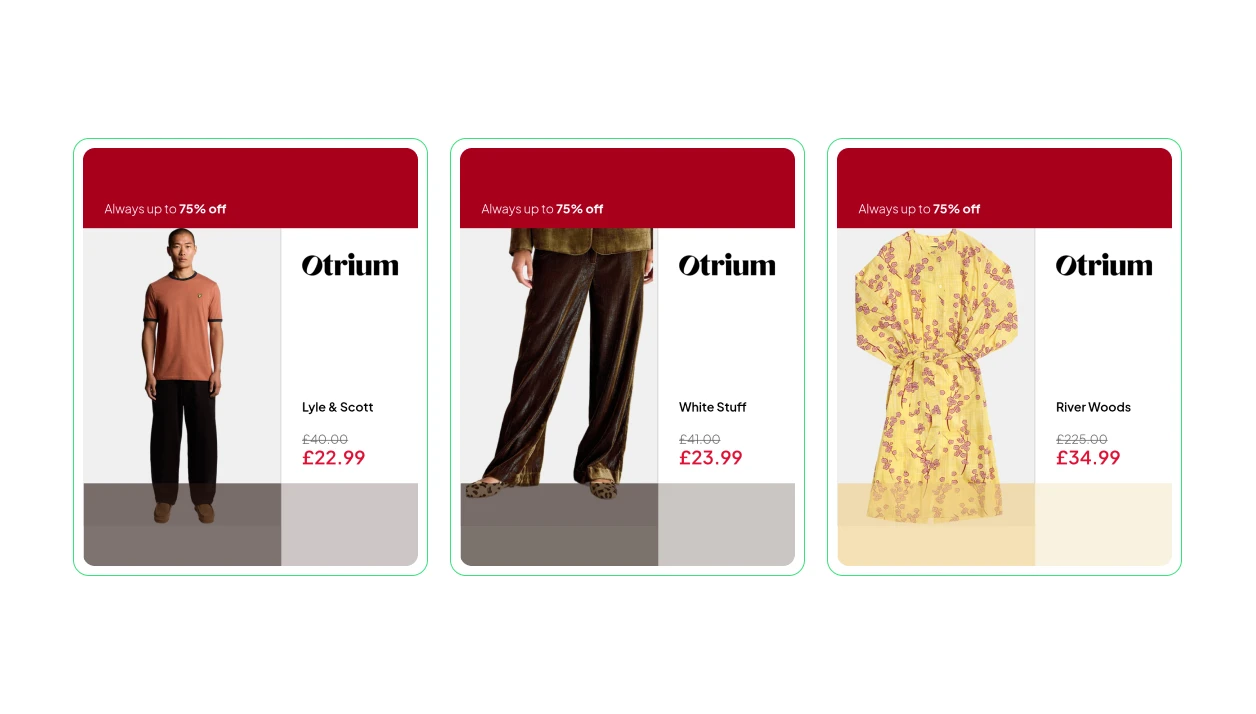
They ran a four-week observational test in February 2026, comparing Hidden Gems sets against their all-products DPA baseline. The results across both markets were consistent. In the Netherlands, Hidden Gems generated a 7.8% revenue uplift and a 41% CTR uplift with flat CPA. In Germany, the set drove a 6.5% revenue uplift, a 30% CTR uplift, and CPA dropped 10% versus baseline.
CVR was lower - expected when you move beyond the full catalog - but higher engagement and incremental purchases more than compensated. This was an incrementality and discovery lever, not a CVR maximizer. Otrium made Hidden Gems a permanent sub-strategy in their retention setup, achieved purely through product-set and messaging differentiation. No budget changes. No campaign restructuring.
Djak Sport used Smart Sets to unlock 2× efficiency
Djak Sport is a major athletic retailer that wanted to determine if segmented product sets could outperform an all-products baseline within their Meta retention layer. They aimed to increase product relevance and purchases without increasing their cost per purchase.
They ran a four-week observational test in 2026, comparing three specific Smart Sets:
Hidden Gems, Best Converters, and Highest Revenue, against their BAU DPA baseline.
The results demonstrated a massive breakthrough in efficiency. While the baseline delivered a 17.6× ROAS, the Best Converters set emerged as the leader, achieving a 36.0× ROAS, a 104% increase.
The efficiency gains were consistent across all metrics. All Smart Sets cut the CPA by approximately 50%, with the Best Converters set driving the CPA down to €1.18 compared to the baseline’s €2.55. While CTR was lower for the Smart Sets, the data suggested this was a feature; the sets reached smaller, more qualified audiences that converted at double the rate of the baseline.

Clear takeaway: by using Smart Sets to define the product pool before the auction, Djak Sport unlocked 2.1× more purchases and 2× more revenue per €1 spent. Following these results, Djak Sport made Smart Sets a permanent part of their BAU retention campaigns.
The bottom line
Meta’s delivery engine performs best when it’s fed the highest-quality signals. You can rely solely on platform-native data, or you can enhance Meta's reach by providing the 1st-party context it needs to thrive.
Smart Sets give you that control by using your own performance data to define which products deserve spend before Meta's auction begins. Otrium proved this with a simple Hidden Gems test that unlocked incremental revenue in two markets without touching their budget or campaign structure. If you're running catalog ads and haven't looked at what your products are actually doing, that's where we'd start.
