





You log into Ads Manager, see a score 58 out of 100, and feel the pull to fix everything on the list. But then the second instinct kicks in: resistance. Because you are also deeply protective of your campaigns. You know why certain settings exist, and which "best practices" already failed in your account.
That tension is at the core of modern advertising. Almost every new social platform update promises easier campaign management through more automation, but the cost is often giving up more control over how campaigns run.
That's why the Meta opportunity score should be treated as a feature, not a verdict.
In this article, we'll break down how the opportunity score actually works, when its recommendations are genuinely worth applying, and when it makes sense to ignore them.
Key takeaways:
- The Meta opportunity score rates your account against Meta-recommended best practices on a 0-100 scale
- A higher score doesn't automatically mean better results
- Some recommendations fit your strategy, others actively contradict it
- Use the score to catch genuine gaps, not as a checklist to follow blindly
- Don't apply suggestions that go against your campaign logic just to move the number
- Chasing 100 for the sake of it helps no one
What the opportunity score actually measures
Opportunity score is a 0 to 100 point metric that represents the degree to which your campaigns are aligned with performance recommendations from Meta. The score is generated by analyzing how many of the recommendations in Meta Ads Manager you have implemented.
Some recommendations may be worth more than others, depending on your campaign objective, business type, budget structure, and historical performance across similar accounts. For example, if your score is 60, it might be improved by addressing audience fragmentation (+35 points) and using Advantage+ placements (+5 points), and applying both could raise your score to 100.
A high score does not guarantee success, just as a low score does not imply failure. It simply reflects the extent to which your campaign structure and settings follow the optimization framework in Meta Ads Manager.

The Opportunity Score's real superpower: Catching what scale hides
Where the opportunity score truly earns its keep is in accounts running dozens of ad sets and hundreds of ads. Nobody can manually audit every setting across that kind of volume every day.
Think about a campaign you launched eight months ago that still runs manual placements because nobody remembered to toggle on Advantage+ placements after it went live. Or an ad set where Conversions API was never configured because the developer who handled it left the company. These are the structural gaps that compound quietly, and the score catches them.
As announced by Meta, advertisers who adopted opportunity score recommendations experienced a 12% median decrease in their cost per result. That's an aggregate, not a guarantee, but it tells you the structural fixes behind the score are backed by real experiment data. Think of the score as a ping system for forgotten settings and configuration gaps across large accounts, not a daily optimization tool for small ones.
The recommendations worth acting on
Not all recommendations carry equal strategic weight. The point value attached to each one is a useful proxy for prioritization. Here's a framework for sorting what matters.
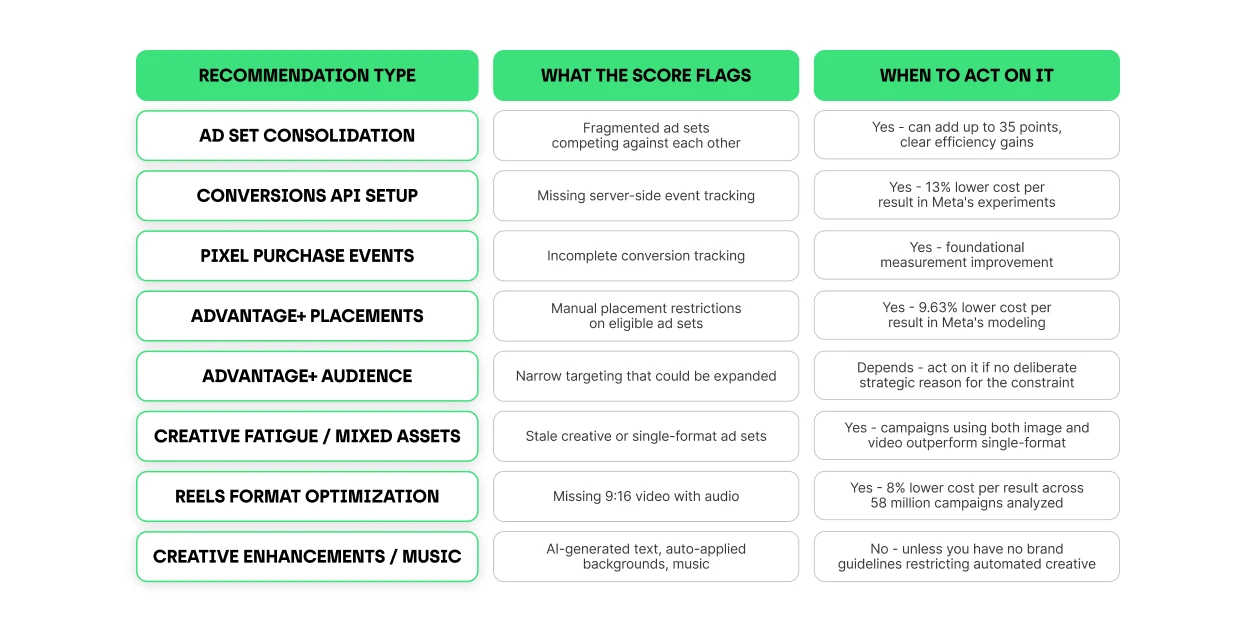
In our experience, the structural and measurement recommendations (consolidation, CAPI, Pixel, placements) are where the score is most actionable for advertisers with brand and margin constraints, because they don't require trade-offs against creative direction or audience strategy.
Audience expansion via Advantage+ audience deserves its own callout. 150 A/B studies from Meta showed a 9.7% lower median cost per result, that's real. But the qualifier matters: if you deliberately narrowed your audience for a specific promotion, the recommendation is noise, not signal.
When to ignore recommendations without guilt
The algorithm operates without any awareness of your strategic intent, brand constraints, or business model context. That's the core limitation, and it's worth naming plainly.
Audience targeting
If you're running a narrow suppression-based promo (say, a 25% discount campaign targeted away from existing customers to protect full-price buyers), the score will flag fragmentation that isn't fragmentation. It's strategy. The algorithm only sees a potential for higher CTR; it doesn't understand you're protecting margin.
Creative enhancements
AI-generated music, auto-applied backgrounds, and automated text variations are the recommendations most likely to conflict with brand reality. If your brand has documented creative guidelines, you can't wholesale delegate these decisions to an automated layer, regardless of the aggregate CTR lift the feature shows across all advertisers.
Brand-sensitive moments
Product launches, seasonal campaigns with specific creative direction, or any campaign where the brand team has defined what the ad should look and sound like. The score's creative suggestions are noise in these contexts.
If a recommendation is not applicable, you can dismiss it. Dismissed recommendations will move to a separate tab and will not impact your score. Your score cap will sit below 100, and that is acceptable, not a failure. A low score on a campaign with tight intentional targeting and strong ROAS is not a problem to solve.
The bottom line
The Meta opportunity score is a structural health check, not a performance verdict. Use it to catch what scale hides: the forgotten placement toggle, the missing Conversions API integration, the fragmented ad sets nobody revisited. Dismiss recommendations when they conflict with deliberate strategy, documented brand guidelines, or campaigns where you already know why you made the choices you did. The marketer stays in charge. The score just makes sure you didn't miss anything on your way out the door.
