





Every major social media update follows the same script: half the industry calls it revolutionary, the other half dismisses it as noise. Meta's Andromeda is no different. But here's where it gets interesting - most of the analysis you'll read focuses on what Andromeda theoretically does rather than what it practically changes for your campaigns.
The biggest misconception about Andromeda is how the algorithm sees your creative and determines what's diverse enough. It doesn't. Meta's been clear about this, even if the message gets lost in translation.
What Andromeda actually does is prioritize creative engagement metrics - click-through rates, view-through rates - as signals for ad delivery. That shift sounds subtle, but it fundamentally changes what "creative diversification" means and how you should approach it.
We’ve taken the time to demystify what Meta Andromeda means for performance marketers and to give our angle on what the signal is to follow and what is just speculation. Here it is.
Key Takeaways
- Andromeda is Meta's AI retrieval system that filters millions of ads down to roughly 1,000 candidates per user based on historical engagement metrics, not visual analysis. It prioritizes creative performance signals like click-through rates, view-through rates, and dwell time rather than scanning what your ads look like.
- Creative diversification means building ads that generate different engagement patterns, not just visually different versions of the same concept. If users drop off before seeing your variation, Meta can't learn from it. Focus on different hooks, pacing, and formats that produce measurably different user behavior.
- Successful advertisers are radically simplifying campaign structures with fewer campaigns, fewer ad sets, and broader targeting. Complex hierarchies starve Andromeda of the data and budget needed for effective learning, fragmenting delivery across too many variations.
- Dynamic product ads remain an underused opportunity because Meta's automation stops at the catalog level. Product image changes don't trigger learning phases, meaning product-level creative optimization is entirely in your control while most advertisers focus elsewhere.
What is Meta Andromeda
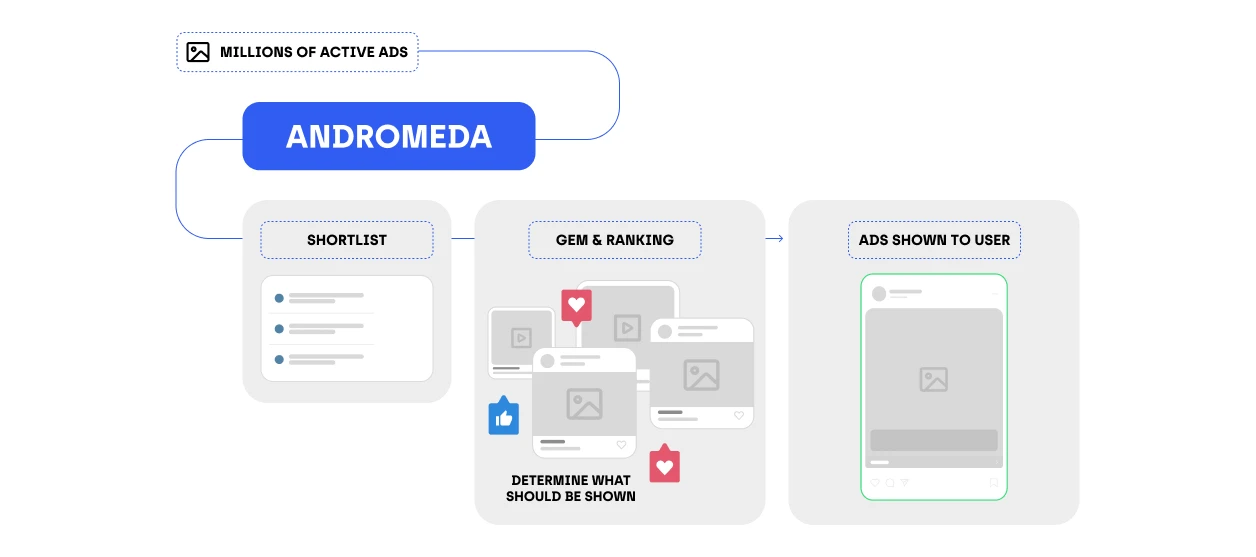
Andromeda is Meta's AI-driven retrieval system that decides which ads are eligible to be shown to a specific user. It's the first filter in Meta's ad delivery process.
When someone scrolls their feed, Meta scans millions of active ads and uses Andromeda to narrow them down to roughly 1,000 candidates. This shortlist then moves to later stages- GEM (Meta’s Generative Ads Model) and ranking, that determine what actually appears.
The key distinction: Andromeda picks what can be shown by evaluating historical engagement, ad copy, creative, and format. Later systems decide what should be shown.
Meta rolled this out in late 2024 and made it core infrastructure in 2025. The company reports Andromeda is "4x more efficient at driving ad performance gains" compared to original models, yielding an 8% improvement in ads quality.
Signal vs. speculation - What we actually know
Meta has confirmed one thing explicitly: creative diversification matters more than targeting granularity now. But what "creative diversification" actually means is where speculation takes over.
Confirmed: Creative performance metrics matter more
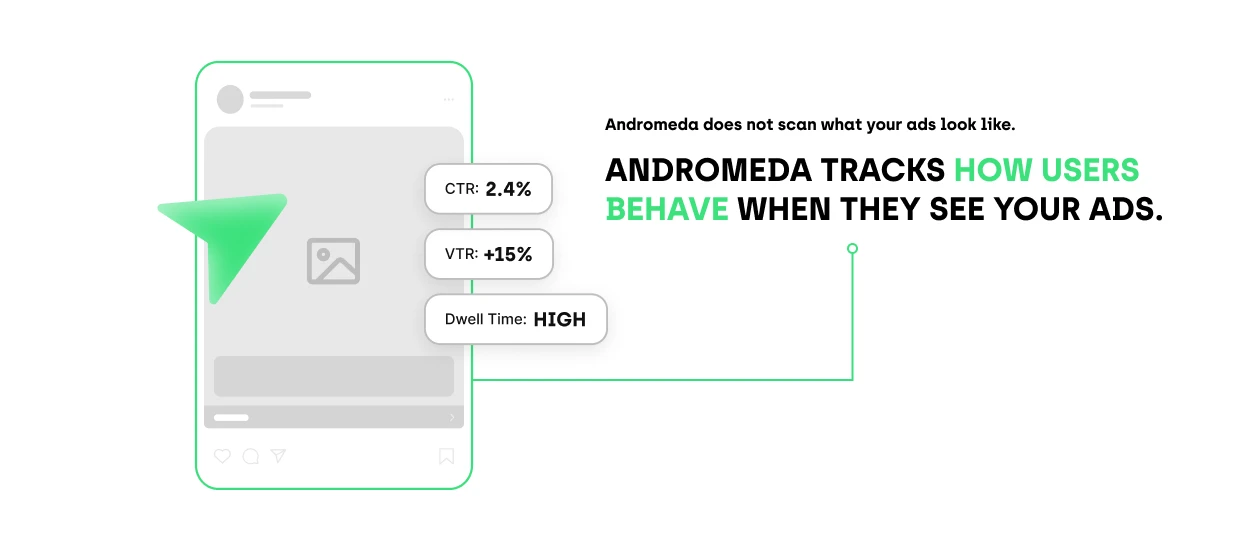
From everything we've seen in Meta's documentation, Andromeda focuses on how users interact with creative - click-through rates, view-through rates, interaction rates, dwell time. Meta's reporting API now exposes more granular signals: video quartiles, where users click, sound on/off status. These are behavioral metrics, not visual assessments.
What's not confirmed: Visual recognition as primary
Many assume Meta uses sophisticated computer vision to determine creative diversity - scanning your ads and flagging similar visuals. We haven't found evidence supporting this. Meta doesn't necessarily know what's in your creative visually. It knows how users respond to it. That's the distinction that matters for your strategy.
Where creative diversification actually matters (And where It doesn't)
Creative diversification means creating ads that generate different engagement patterns.
Here's why this matters: if you have two 15-second videos where only the last 5 seconds differ, but your view-through data shows most users stop watching after 5 seconds, Meta can't learn from that difference. The users never encounter the variation.
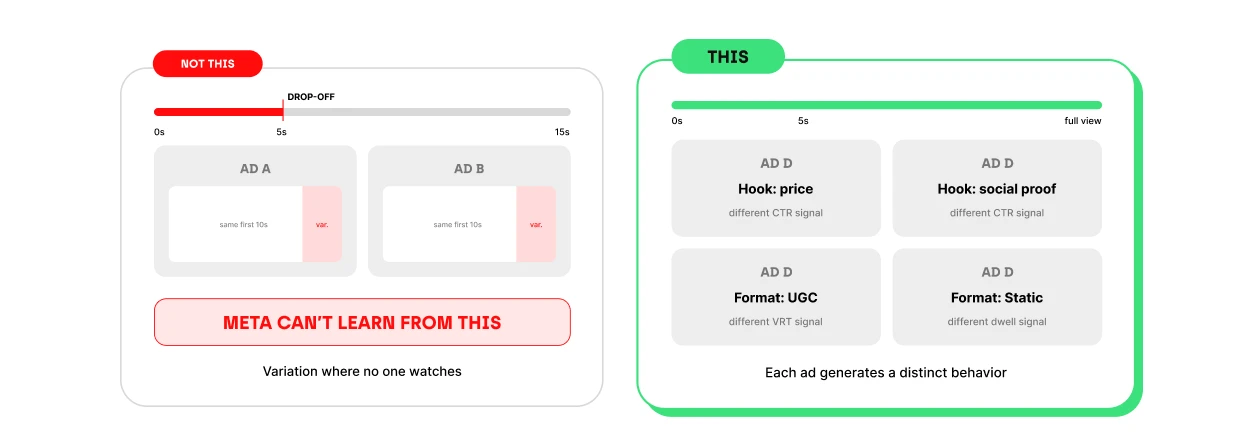
Meaningful diversification means building ads for different people and contexts, not just different versions of the same idea. The creative differences need to appear where users actually engage.
The dynamic product ad exception
For DPA advertisers, there's one interesting thing we've noticed: product images are low-impact assets in Meta's optimization.
We know this because you can change product images in your catalog hourly without triggering the learning phase. Meta doesn't treat that visual as a high-impact signal. Instead, it optimizes DPA based on product sets and catalogs, not individual images or templates.
This means creative remains a largely untapped lever for DPA - Meta's automation doesn't optimize at that level.
How does Andromeda change how you build campaigns?
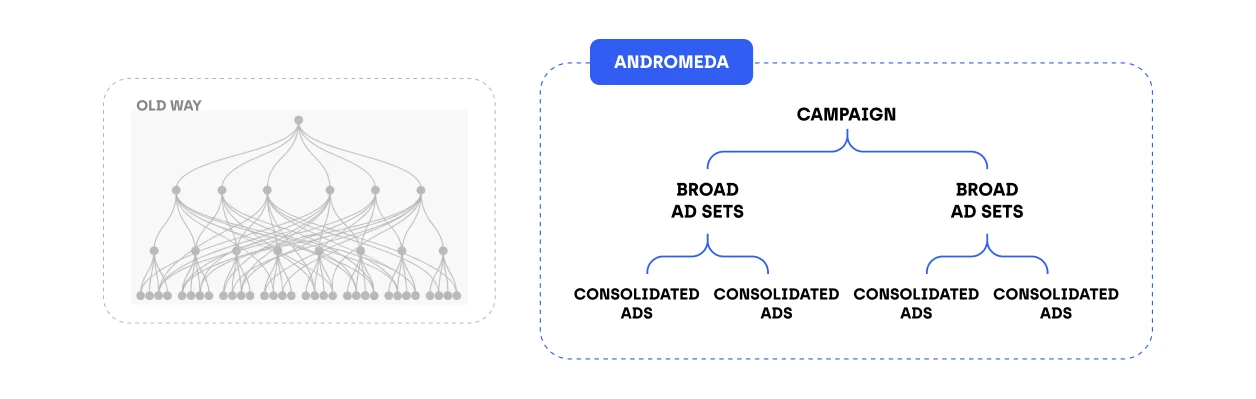
You’ve already noticed this: radical simplification of campaign structure. Complex account hierarchies starve Andromeda of the data and budget it needs to learn effectively.
We're seeing successful advertisers consolidate aggressively - fewer campaigns per objective, fewer ad sets per campaign, broader targeting within ad sets. Why? When creative supply dramatically outweighs budget, the system can't distinguish signal from noise. Learning slows, delivery fragments across too many variations.
The ad limit change reinforces this. Meta removed their "no more than six ads" recommendation, likely because Andromeda can handle more creative volume - but only when structure and budget support proper learning.
Testing frameworks shift, too. Instead of throwing everything at the wall, define what you're actually testing, isolate variables, and document what performs. Strengthen signals rather than dilute them.
Hunch's take on Meta Andromeda
Creative diversification should be treated as a performance signal exercise, rather then visual exercise. You don't need creatives that look different - you need creatives that generate measurably different user behavior. Different hooks affecting CTR. Different pacing affecting view-through rate. Different formats affecting interaction.
As our Head of Product, Nebojsa Knezevic, puts it:
By focusing solely on Andromeda optimization for standard campaigns, you'll be missing the DPA opportunity. Meta's automation handles catalog-level decisions, but product-level creative optimization? That's still on you. It's an underutilized lever with less competition.
What hasn't changed: quality execution, clear offers, and strong conversion paths still matter more than algorithmic optimization.
The bottom line
Andromeda doesn't care if your ads look different - it cares if they perform differently. The system prioritizes creative based on engagement signals. That means your diversification strategy should focus on generating measurably distinct user behaviors, not just visual variety.
The practical shift is clear: consolidate campaign structure, increase creative volume where budget supports it, and test with intention. Document what drives different engagement patterns - different hooks, pacing, formats - rather than churning out surface-level variations.
For DPA advertisers, there's an underexplored opportunity: Meta's automation stops at the catalog level, leaving product-level creative optimization entirely in your hands. While everyone else obsesses over Andromeda-optimized creative for standard campaigns, DPA creative remains a low-competition lever.
If you're looking for hands-on support navigating these changes, Hunch works with eCommerce brands to build testing frameworks that strengthen signals rather than dilute them - particularly for catalog-based campaigns where creative optimization is still manual.
FAQ
Does Andromeda use computer vision to evaluate my creative?
No. Meta doesn't scan your ads visually to determine diversity. Andromeda prioritizes creative performance metrics - click-through rates, view-through rates, dwell time, interaction rates. Meta knows how users respond to your creative, not what's literally in the image or video. The system tracks behavioral signals through Meta's reporting API: video quartiles, click locations, sound on/off status. Focus on creating ads that generate different engagement patterns, not ads that simply look different.
How many ads should I have per ad set now?
It depends entirely on your budget. Meta removed the six-ad recommendation because Andromeda can handle more volume, but only when budget supports proper learning. Running 20 ads with $50/day fragments delivery and starves the system of signal. Focus on genuinely different concepts rather than hitting a number. Each creative should generate measurably different user behavior - different hooks affecting CTR, different pacing affecting view-through rate. Quality and diversity of engagement patterns matter more than quantity.
What makes creative "diverse" under Andromeda?
Ads that generate different user engagement patterns - different CTRs, view-through rates, interaction rates. Visual differences alone don't matter. If you have two 15-second videos where only the last 5 seconds differ, but users drop off after 5 seconds, Meta can't learn from that variation. The creative differences need to appear where users actually engage. Build ads for different people and contexts, not just different versions of the same idea. The variation needs to create measurably different behavior.
Does Andromeda affect dynamic product ads?
Minimal impact. Meta treats product images as low-impact assets in DPA optimization. You can change product images in your catalog hourly without triggering the learning phase, which tells you Meta doesn't heavily optimize at that level. Instead, Meta optimizes DPA based on product sets and catalogs. This means creative remains an underutilized lever for DPA advertisers - the automation stops at the catalog level, leaving product-level creative optimization entirely in your control.
Should I completely change my campaign structure?
Simplify, but test in your context first. Consolidate to fewer campaigns per objective, fewer ad sets per campaign, broader targeting within ad sets. Complex hierarchies starve Andromeda of data and budget needed for learning. When creative supply dramatically outweighs budget, the system can't distinguish signal from noise. That said, don't make wholesale changes based on theory. Document current performance, test simplified structures incrementally, and strengthen signals rather than dilute them across fragmented delivery.
