




In gaming and iGaming, performance is increasingly decided by creative testing speed. Platforms handle most bidding and optimization. What separates strong results from stalled performance is how fast brands can launch, rotate, and learn from new creative.
The challenge is not knowing what to test. The challenge is executing fast enough without growing costs out of control. Today, gaming brands usually choose between three models: working with agencies, building in house, or running campaigns through Hunch.
Model 1: Scaling creative testing with an agency
Agencies make it easy to get started. They handle campaign setup, upload creative assets, monitor CPI and frequency, and rotate ads when performance drops. For brands at lower spend levels, this model often works fine.
The issue appears as spend grows. Most agencies charge a percentage of media spend. At $200K per month, a 10% fee already means $20K. At $500K, that number climbs to $50K or more, even though the core execution work remains similar.
At that stage, brands are mostly paying for operational execution at scale. Launching ads. Swapping creatives. Updating bids. The cost grows with budget, not with the actual complexity of the work. Creative testing speed is still limited by how fast manual workflows can move.
Model 2: Scaling creative testing in house
Bringing performance in house removes the percentage fee, but introduces a different bottleneck. You need someone who understands statistics, platform mechanics, and campaign execution. That combination is rare. Even if you find it, you are paying $80K to $120K annually for one person whose primary job becomes manual launch work.
Managing 50 variations takes almost the same time as managing 200 when execution happens inside Ads Manager. Bandwidth becomes the limiter. Hunch removes that ceiling by turning execution into background automation.
Model 3: Scaling creative testing with Hunch
Hunch reframes the problem entirely by removing manual execution as the constraint.
Instead of building campaigns inside ad platforms, gaming teams run campaigns from a spreadsheet. Each row represents a campaign or ad set. Columns define budgets, audiences, creative URLs, bid logic, and status rules. Hunch reads that structure and executes everything through the platform APIs.
Change a budget in the sheet and it updates live. Add new rows with creative variations and they launch automatically. Mark ads as paused based on CPI or frequency rules and Hunch applies those decisions without manual action.
Execution becomes background infrastructure instead of daily workload.
Where creative templates change the equation
Creative testing speed depends on how fast new variations can be produced and launched. This is where templates play a central role.
With Hunch, one Photoshop or Figma template becomes a creative engine. Game titles, jackpots, CTAs, and offers are mapped to spreadsheet columns. When new values are added, dozens of variations are generated automatically in both square and vertical formats.

Instead of producing each asset manually, creative becomes data driven. Testing volume scales without scaling design workload.
Why this matters more in gaming than most verticals
In gaming and iGaming, creative fatigue hits fast. Frequency rises quickly. CPI doubles once the same angle is shown too many times. The operators who refresh creative fastest maintain auction advantage.
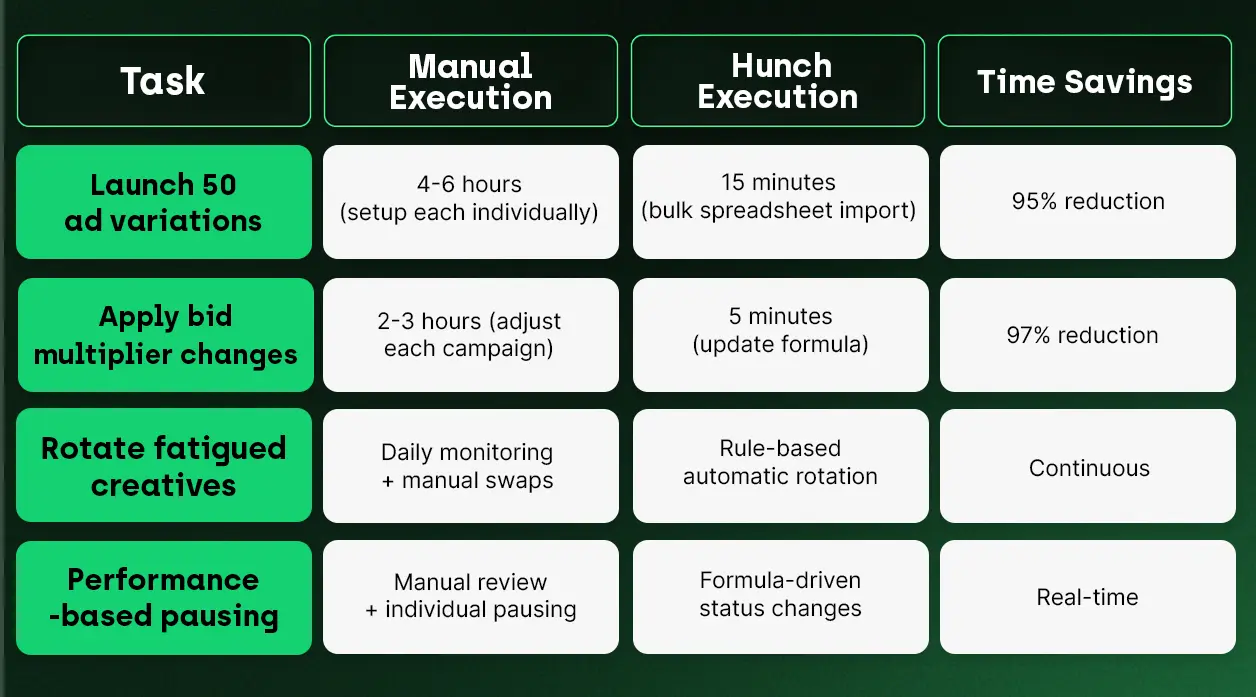
Manually, most teams might test 30 to 40 variations per month. With Hunch, that same team can realistically test 200 or more in the same timeframe because setup, rotation, and pausing are automated.
This is not a minor efficiency gain. It directly changes how often winning creatives are discovered.
Main Takeaway: What actually changes across the three models
With an agency, creative testing is limited by manual capacity and scales in cost with spend.
With an in-house team, creative testing is limited by human bandwidth.
With Hunch, creative testing is limited mainly by how fast teams can generate ideas and update a spreadsheet.
Campaign setup drops from hours to minutes.
Creative rotation follows rules instead of reminders.
Bid and budget changes propagate automatically.
Teams move time from clicking to strategy and creative direction.
The Bottom Line
Gaming brands do not lose performance because they lack ideas. They lose performance because execution cannot keep up with how fast the platforms reward testing.
Agencies scale cost with spend. In-house teams scale limits with time. Hunch removes execution as the limiting factor altogether.
For brands that want to scale creative testing without scaling headcount, the difference is not about who clicks faster. It is about whether execution is still manual or built into the system.
We’ll leave you with related customer stories, because nothing we can say can beat what our customers say about us!
