





Catalog ads work the same way across industries. In ecommerce, they promote SKUs. In travel, destinations. In publishing, articles.
Once an article enters a Meta catalog, it becomes a feed item. Meta dynamically assembles ads from it, distributes them efficiently, and reports results at the ad-unit level. That setup works well for scale, but it obscures the signal content teams care about most: which specific article actually converted a reader into a subscriber.
This blind spot is common among publishers using catalog ads for content promotion. It is also exactly the kind of operational problem Hunch is built to solve.
This article is for you if:
- Your monthly paid social spend is between $200K and $1M
- You operate in publishing or local news
- Your primary paid media market is the US
The article-level tracking problem
Catalog-based content promotion bundles multiple articles into a single dynamic ad unit. Meta reports conversions for that unit as a whole, not for individual stories.
The result is familiar. Subscriptions come in, performance looks healthy, but no one can say which article triggered the conversion. Marketers know campaigns are working, but editorial teams lose visibility into which stories resonate strongly enough to turn readers into paying subscribers.
Without article-level attribution, scaling becomes guesswork. High-performing stories are not amplified fast enough. Underperforming content continues to spend. Editorial and growth teams lose the feedback loop that should connect content decisions to subscription outcomes.
Why catalog-based dynamic ads create blind spots
Most publishers rely on RSS feeds to populate content catalogs. Articles are grouped into collections and treated as a single object by Meta. That structure simplifies delivery, but it collapses reporting.
Impressions, clicks, and conversions are aggregated across the entire collection. The data exists, but the reporting layer makes it impossible to identify which article meaningfully contributed to results. This limits optimization, planning, and cross-team collaboration.
The cost of aggregated performance data
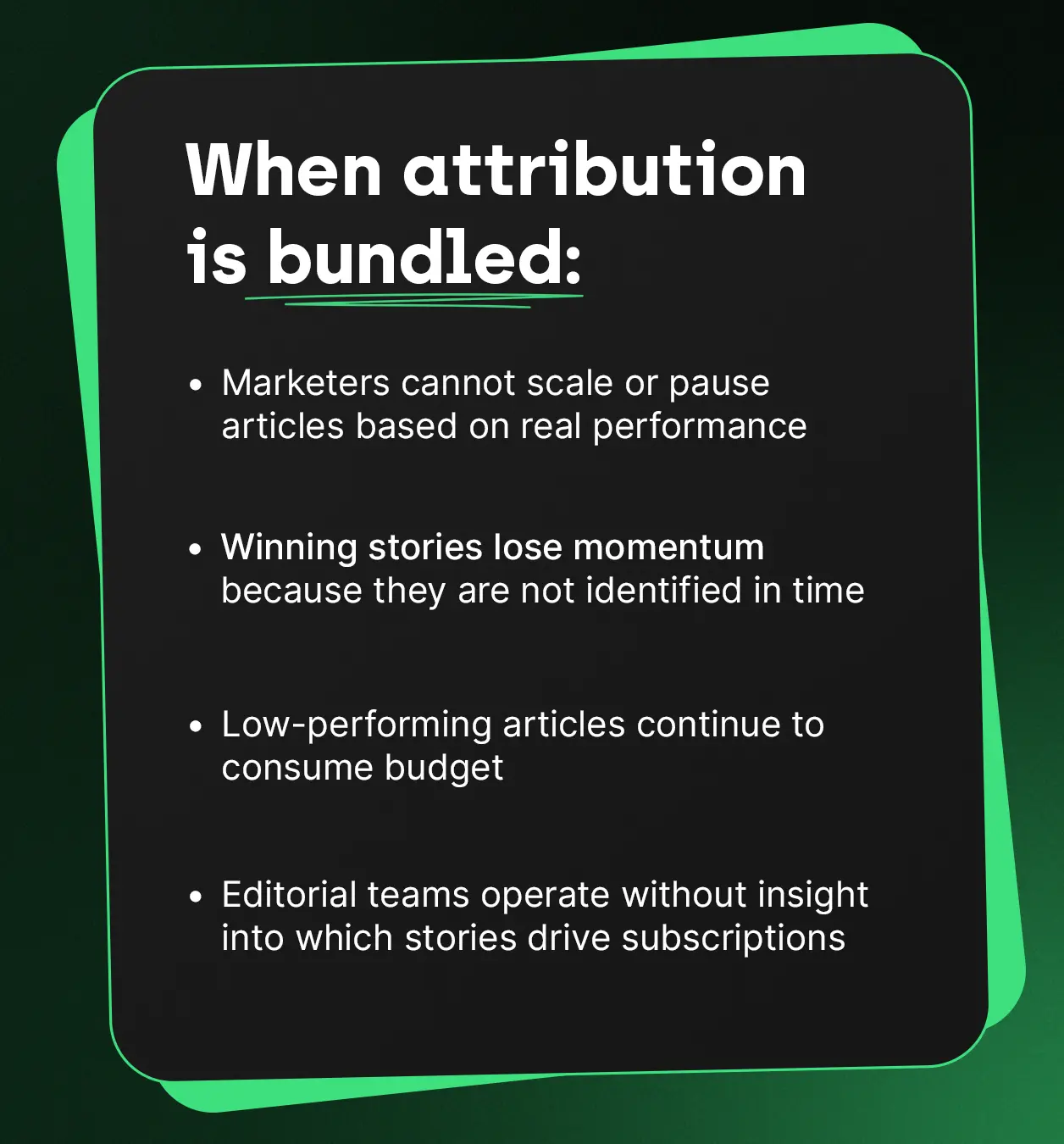
Over time, this slows growth and weakens confidence in paid content promotion as a scalable channel.
When scale meets platform limits
Ad account ceilings
Large publishers promoting dozens or hundreds of articles across multiple properties quickly run into Meta’s ad-account limits. To stay within those constraints, articles are grouped together. Grouping enables scale, but it reinforces the attribution problem.
Teams are forced into a tradeoff between operational scale and performance clarity.
Mobile formats and creative bottlenecks
Most editorial images are horizontal. Social platforms prioritize vertical mobile formats. Automated cropping rarely produces clean results, and manually creating vertical assets for hundreds of articles across many properties is not sustainable.
As promotion scales, creative production becomes the bottleneck long before distribution does.
Structuring content promotion for article-level clarity
This is where Hunch changes the model.
Instead of treating articles as loosely grouped catalog items, Hunch structures each article as its own controllable unit. Article data lives in a centralized feed, where every row represents a single story with its own headline, image, brand, location, page ID, and budget.
That feed becomes the operational backbone of content promotion.
Hunch syncs this structured data across all connected ad accounts automatically. Teams no longer need to rebuild campaigns, log into multiple accounts, or compromise on attribution to stay within platform limits.
Each article remains distinct. Performance stays visible.
Performance-driven optimization at scale
Once articles exist as individual items, optimization becomes practical.
Hunch continuously reads performance data and applies rules defined by the team. If an article exceeds a cost-per-subscription threshold, it can be paused by updating a single field. If another story converts efficiently, budget can be increased just as easily.

All changes happen through the feed. Hunch handles the execution inside Meta without manual intervention in Ads Manager.
This creates a tight feedback loop between performance data, budget decisions, and editorial outcomes.
The bottom line
Article-level attribution turns content promotion from a black box into a measurable growth engine.
By treating articles as structured, independent units, publishers gain:
- Clear visibility into which stories drive subscriptions
- Scalable creative production across mobile-first formats
- Centralized control across multiple properties and ad accounts
- Faster optimization without operational overhead
Hunch enables this shift by combining structured data, automated templates, and centralized execution. The result is a cleaner workflow, better collaboration between teams, and the ability to scale what actually works.
When your feed is structured and your templates are in place, every article gets a fair chance to perform. Subscription-driving stories surface quickly and can be amplified at the right moment.
The simplest way to validate the model is to start small. Launch with a limited set of articles in one market, confirm article-level attribution, then scale the same structure across all properties.
